Feeds:
Posts
Comments

Archive for the ‘Birding’ Category

My son Dave visited Yunnan shortly after he moved to China in 2008.  For years, he has urged me to see this province of China that is often considered the most beautiful.  So, when Nick Bray, who led my birding trip in 2012, posted on Facebook that he was planning Zoothera Birding‘s first trip to Yunnan, I immediately signed up.

Common Kingfishers are widespread in Asia and I have seen them on every trip, this time in both Yunnan and later in Shenzhen.

Common Kingfishers are widespread in Asia and I have seen them on every trip, this time in both Yunnan and later in Shenzhen.

I arrived in Kunming in the wee hours of January 16th, a full day before the others so that I wouldn’t be starting the trip with jet lag.  I planned to sleep late and then do a little birding on my first day.  I thought that I was so smart when I was preparing for the trip and found a little park not far from the hotel.  I printed the map so that I could show it to a taxi driver as no taxi drivers in China speak any English.  The hotel called a taxi for me and, as planned, I showed my little map to the driver.  I assumed that he would take me to the park, but after a few minutes he showed me his phone with a translation app.  It said “That park is old and depressed.  Why do you want to go there?  Guandu Forest Park is new and beautiful and it’s free.”  I tried to ask how far the suggested park was, but the translation app turned “How far is the park?” into profanity.  I vigorously shook my head “no” and gave up.  So, of course, the driver took me to the suggested park, 45 minutes away and $15.00 rather than 10 minutes and the $3.00 fare that I expected.  I was frustrated, but I should have known better.  After four previous trips to China, I have learned that communication is difficult and misunderstandings are frequent, even when simply trying to get from Point A to Point B.

Yellow-billed Grosbeak

Yellow-billed Grosbeak

The park was a typical Chinese city park – full of people, even a band playing – beautiful, but not conducive to productive birding.  But, I quickly relaxed and enjoyed the lovely afternoon for a couple of hours.  Even with all the activity, I found a little flock of Yellow-billed Grosbeaks, a species that the Zoothera group would not see at all.

Back at the hotel, I found a few birds on the edge of the parking area, including several White Wagtails.  I find Wagtails very interesting and always try to photograph them.  This was the first time that I saw an alboides subspecies and I thought that he was a rather snazzy looking bird, even in winter plumage.
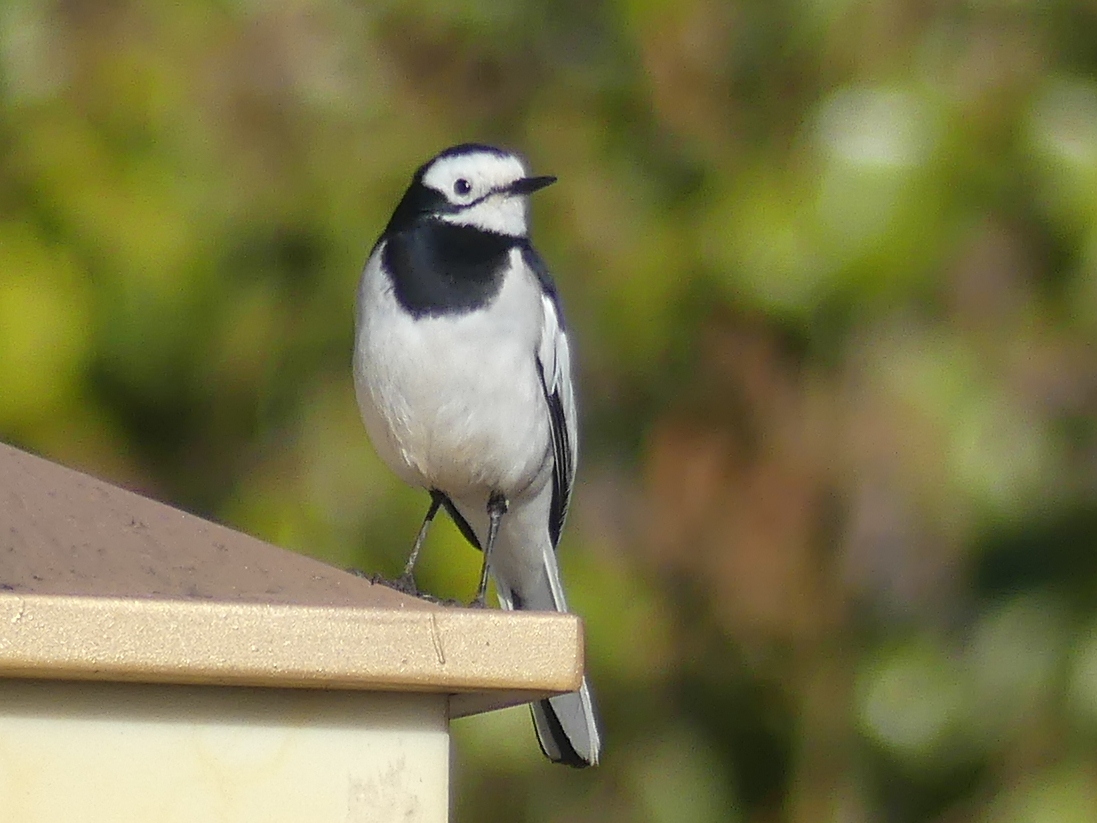
White Wagtail, Motacilla alba alboides

White Wagtail, Motacilla alba alboides

That evening I enjoyed dinner with John Hopkins, another birder who had arrived early.  The next day we met up with the rest of the group at the airport – ten participants and three guides.  There was one other woman in the group, from Germany, and one man from Sweden.  The rest of the group consisted of males from the UK except for our two Chinese guides.  After a quick lunch, we were off on our adventure.  Our first destination was Zixishan, a mountain park near Chuxiong, about three hours from Kunming.  We arrived in time for a little birding before checking into our hotel and we found our two target birds right away – the endemic Yunnan Nuthatch and Giant Nuthatch.  The Yunnan Nuthatch posed quite nicely for us at a close distance, not typical behavior we were told.

Yunnan Nuthatch

Yunnan Nuthatch

The following day, we started birding at Zixishan before sunrise.  It was a nice morning and we saw a good number of birds.  This Chinese Thrush sat on the side of the road and never moved, even as we moved closer and closer for photos.  It was still sitting there when we left to look for other species.

Chinese Thrush

Chinese Thrush

The afternoon brought a 6-hour drive to Lijiang where we hoped to see Biet’s Laughingthrush, my most wanted bird of the trip.  But, alas, our good fortune at Zixishan did not continue at Lijiang.  Despite several hours of intensive searching in the areas where the laughingthrush has historically been seen, we neither heard nor saw one.  We learned that this rare bird is becoming increasingly difficult to find, perhaps in part due to illegal poaching for the caged bird trade.

The best birds at Lijiang were a pair of Rufous-tailed Babblers bouncing around the top of a big trash pile, singing almost constantly.  Several of us just sat in the grass a few yards away with our cameras and click-click-clicked as these normally shy birds put on a fantastic close-up show for us.

Rufous-tailed Babbler

Rufous-tailed Babbler

The others in our group had started teasing me about ducks almost as soon as our trip started.  Apparently I was the only waterfowl enthusiast, or maybe ducks were just too easy for the more serious birders with life lists of over 6,000 species.  I got my wish to see ducks on the morning that we left Lijiang with a quick stop at Lijiang Wetland Park.  I loved it!  There were hundreds of birds on the lake.  I got much better looks at beautiful Ferruginous Ducks than I’d had previously.  And, I even got three life birds.  Surprisingly, I had never seen a real wild Graylag Goose before.  Red-crested Pochard and Smew were also new.

Ferruginous Ducks

Ferruginous Ducks

It seemed that everyone enjoyed our short time at the wetland despite their earlier claims that they didn’t care about ducks.  I think that we could have stayed for hours and everyone would have been happy.  But, we had a long drive ahead, so we couldn’t savor the ducks and wetland birds for long.  Back in the van, the more experienced birders gave me a good lesson in separating Black-headed and Brown-headed Gulls.  With their expert knowledge and my photos, I quickly learned that it really was easy to differentiate these two species.

Brown-headed and Black-headed Gulls with Graylag Geese. Even in this rather poor photo, you can easily note the larger size of the Brown-headed Gulls, the dark wingtips, and huge mirrors in the outermost primaries.

Brown-headed and Black-headed Gulls with Graylag Geese. Even in this rather poor photo, you can easily note the larger size of the Brown-headed Gulls, the dark wingtips, and huge mirrors in the outermost primaries.

After leaving the Lijiang wetland, we drove 8 hours to Lushui.  The next morning we continued through part of Gaoligongshan National Nature Reserve, over Pianma Pass (3,100 meters), and to the small town of Pianma near the Myanmar border where we would spend the next two nights.  The first morning in this area started with one of the most thrilling sightings of the entire trip – and it was not a bird.  It was a Red Panda sleeping in the sunshine in a bare tree!  This charismatic little mammal (about the size of a house cat) is fascinating.  It has thick fur on the soles of its feet.  It uses that fluffy 18-inch tail to wrap around itself for warmth.  The Smithsonian has more interesting facts about the Red Panda, a species classified as endangered with a population of less than 10,000 remaining in the wild.

The Red Panda as seen from the road.

The Red Panda as seen from the road.

A close-up of the adorable Red Panda. This is the view that we got through the scope. Photo by John Hopkins.

A close-up of the adorable Red Panda. This is the view that we got through the scope. Photo by John Hopkins.

After the panda sighting, things were pretty slow.  Actually, they were very slow and this was my least favorite part of the trip.  The hotel was awful, it was cold, and we didn’t find our main target birds.  For two full days, we traveled back and forth over Pianma Pass and birded along the road, which was always covered in a thin layer of ice except in sunny spots.  On the second day, several of the others found some good birds by climbing up the side of the mountain on rough rather steep trails.  I stayed on the road not wanting to wear myself out or trigger an asthma attack by too much activity at 3,100 meters.  OK, I was a little lazy.  But, my vision is so bad that I don’t think that I would have seen the birds anyway, even if I had scrambled up the mountainside.  Just like on my 2012 trip with Nick, most of the others were in better physical shape and were much more experienced and skillful birders than me.  But I didn’t miss one of the best birds of the day when late that afternoon we found this spectacular little bird, a Fire-tailed Myzornis.
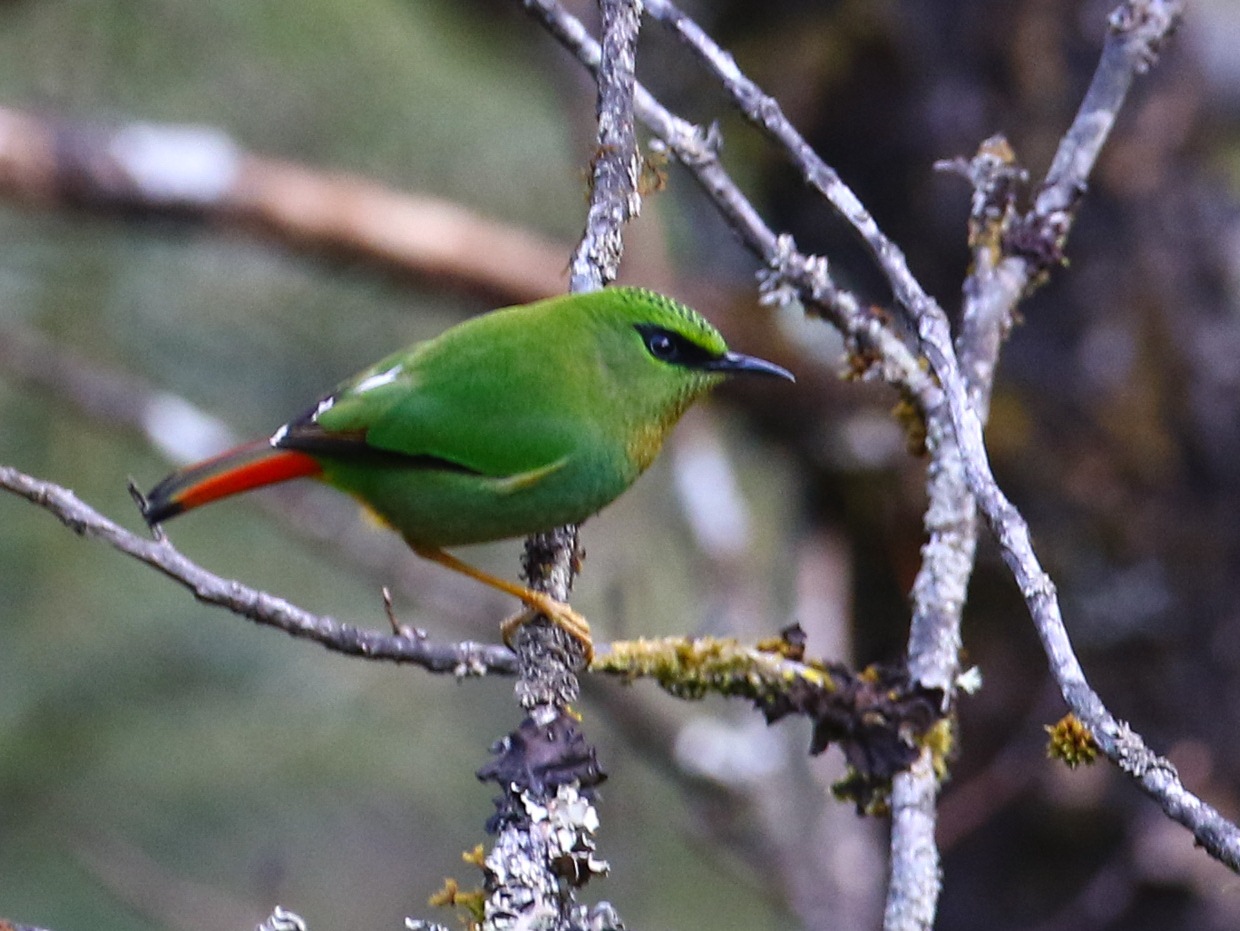
Fire-tailed Myzornis. Photo by John Hopkins.

Fire-tailed Myzornis. Photo by John Hopkins.

The following morning, we left for Baihualing and it’s many bird blinds, where I would be in birding heaven.  Stay tuned.

Read Full Post »

My second trip to Arizona was a few weeks ago.  I find that I can’t think about that trip without also recalling memories from my trip in April 2010.  The first trip was short – just four days – but I got 67 life birds!  My recent trip was a little longer – six days – but with more experience now, I was pleased to add just nine birds to my life list (plus one new ABA area bird).  Perhaps it’s the contrast that makes me acutely aware of the stages we go through as birders and the joys of it all.  In 2010, I remember my head spinning at Patton’s as I got three life birds in about three minutes.  “Oh, a Lincoln’s Sparrow.”  “Quick, over there – Lazuli Bunting!”  “Stop looking at those birds.  There’s a Violet-crowned Hummingbird at the feeder!”  My friend Susan and I birded from dawn to dusk with time for only one real meal.  It was wonderful fun, but sadly I have no photos at all from that trip.  The trip in November 2018 was with another friend, Diane.  Instead of mad dashes from one lifer to another, we had time to savor and study.  It was a different trip entirely, but just as enjoyable.

No Violet-crowned Hummingbirds on my recent trip, but Blue-throated Hummer was a lifer and one of my favorites.

No Violet-crowned Hummingbirds on my recent trip, but Blue-throated Hummer was a lifer and one of my favorites.

On our first day, Diane and I found life bird number one of the trip – adorable Rosy-faced Lovebirds.  We have no explanation for the “beads.”  Suggestions on Facebook included marking by a researcher or perhaps a pet escaped and joined the wild flock.  These colorful little parrots are popular cage birds.  Escaped pets became established in the wild and for over 30 years they have been breeding in residential neighborhoods in the Phoenix area.

Rosy-faced Lovebirds nest in the palm trees.

Rosy-faced Lovebirds nest in the palm trees.

Because I was such a new birder in 2010, life birds on that trip included quite a few common species.  I clearly remember being excited to see Brewer’s Blackbirds.  Susan could not understand my joy.  “Shelley, they aren’t classy birds.  They’re eating horse shit.”  But, she then conceded that every birder got their life Brewer’s Blackbird at some point.

This year, none of my desired lifers were widespread common birds.  Some of our targets would be challenging to find, so Diane and I hired local expert Melody Kehl for three days.  Melody delivered the first morning with Gilded Flicker, a bird that is found almost exclusively in Arizona.  I have now seen all 22 North American species in the woodpecker family.

My life Gilded Flicker

My life Gilded Flicker

Next, Melody found Rufous-winged Sparrows for us and then Black-capped Gnatcatchers, a primarily Mexican species that reaches its northernmost range in Southeast Arizona.  We had good looks, but the gnatcatchers did not cooperate for photos.

Diane had missed Elegant Trogon on her first trip to Arizona in 2010 and it was one of her most-wanted birds.  I told her to forget it, it was the wrong time of year and would be extremely unlikely.  But, guess what Melody found at the Madera Canyon picnic area?  Yep, an Elegant Trogon!  Madera lived up to its reputation for good birds that day with Olive Warblers, a Blue-throated Hummingbird, Hepatic Tanagers and many others.  One of my favorites was this Red-naped Sapsucker eating berries.  I had seen my lifer just a few months earlier in Montana, but this was my first good close look.

Red-naped Sapsucker

Red-naped Sapsucker

On our second day with Melody, we went to Santa Cruz flats to look for sparrows and raptors.  We struck out on Sagebrush Sparrow; apparently they had not arrived yet for the winter.  But, I was thrilled with the Prairie Falcon that we did find.  I had wanted this falcon as a life bird for a long time.  Now I was looking at a gorgeous cooperative bird.  I think that I can see hearts in the spots on its thighs.  Look at that face!  I am in love with this bird!

Prairie Falcon

Prairie Falcon

I have seen very few Barn Owls, any place, ever, so it was a thrill to also see these beautiful birds that day.  Doesn’t everyone, birder or not, love owls?  Barn Owls are one of the most widespread of all birds, found on every continent except Antarctica.  But widespread does not mean common and most owls are very sensitive to disturbance, so we just took a quick look, used no flash for photos, and did not disclose the exact location of these birds.

We were privileged to see these beautiful Barn Owls.

We were privileged to see these beautiful Barn Owls.

We got back early enough that afternoon that Diane and I had time to visit Reid Park, not far from our hotel.  We were amazed to see dozens of American Wigeons competing with Mallards for bread that kids were throwing.  Even an immature Black-crowned Nigh-Heron joined in the feeding frenzy!  While feeding bread to ducks is a common practice, it is not a good idea.  See this for 3 reasons you shouldn’t feed bread to ducks.

An immature Black-crowned Night-Heron joined the ducks snapping up bread thrown by the kids.

An immature Black-crowned Night-Heron joined the ducks snapping up bread thrown by the kids.

We headed to the Chiricahua Mountains on our third and last day with Melody.  Another much-wanted life bird, Crissal Thrasher, started the day.  We got a good look, but it was too quick for photos.  We then searched for Juniper Titmouse which Melody found and Diane saw well.  But, with my poor vision, I did not see the birds well enough to count them.  Next time.

An Acorn Woodpecker at the George Walker House in the Chiricahua Mountains. A common western species, but always fun to see.

An Acorn Woodpecker at the George Walker House in the Chiricahua Mountains. A common western species, but always fun to see.

After a morning of exploring the mountains and visiting several yards with feeders, we had a wonderful picnic lunch at Barfoot Park.  Just as we finished our meal, Melody heard Mexican Chickadees.  Mexican Chickadees, as their name implies, are primarily a Mexican species which occur in the US only in the Chihuahua and a small mountain range in New Mexico.  These birds were our main reason for the long drive from Tucson that day.  With some effort, we saw about a dozen birds and I even got so-so photos.  The timing could not have been better if Melody had trained those chickadees!

Mexican Chickadee

Mexican Chickadee

Diane and I then had two more days before we had to be back in Phoenix for our flights home.  We decided to spend our last night near Tucson at WOW Arizona so that we could bird there in the afternoon and again the following morning.  This wildlife sanctuary/B&B with numerous feeding stations was the perfect place for close-up study of many species we had seen during the previous days.  A bonus was watching a gorgeous Harris’s Hawk, a new species for the trip, come for its chicken leg supper.

Harris's Hawk waiting to come down for its supper.

Harris’s Hawk waiting to come down for its supper.

WOW Arizona was very relaxing.  We just walked around a bit and sat in front of the feeders watching beautiful birds.

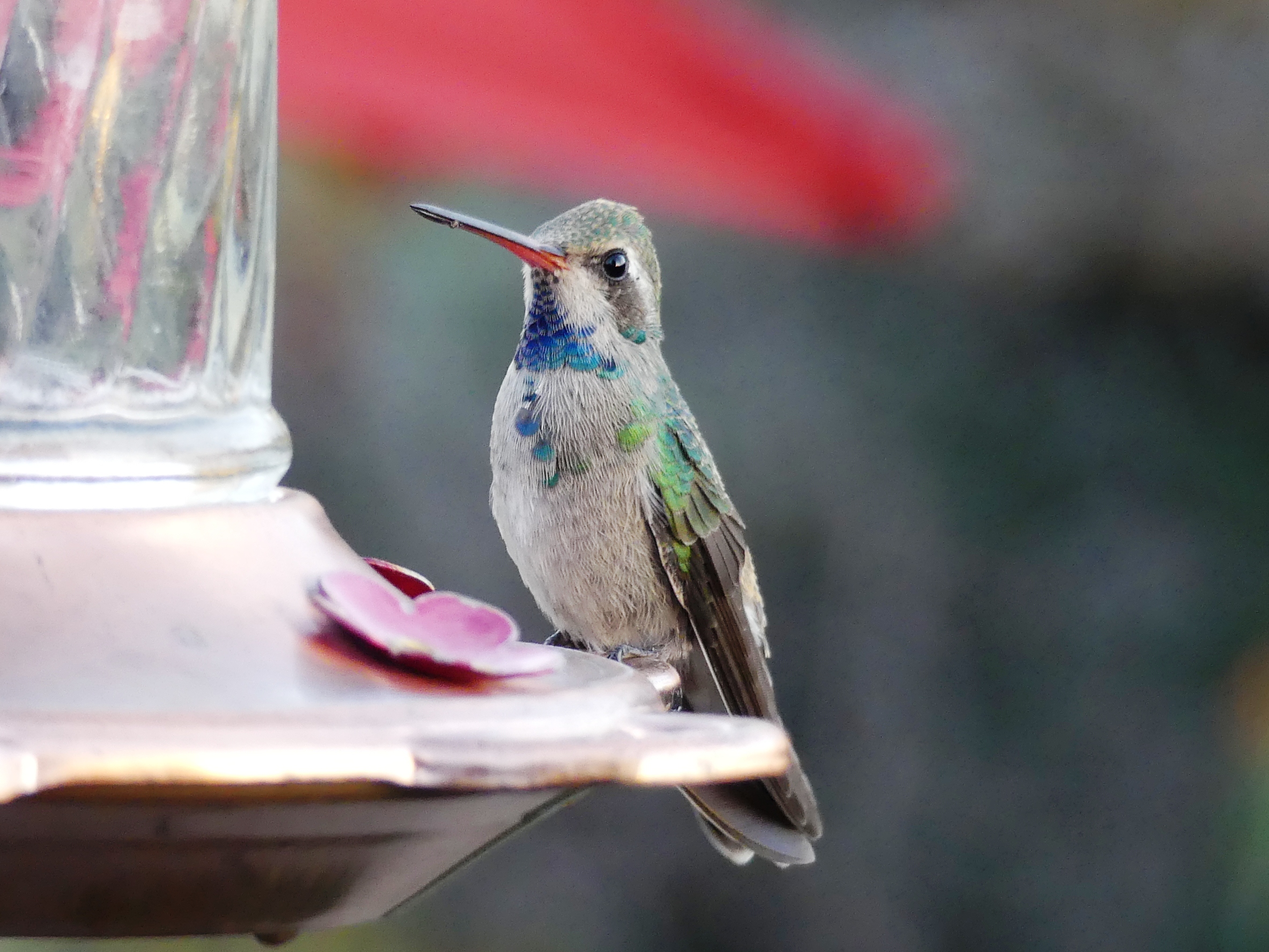
The many hummingbirds at WOW Arizona provided a good opportunity to study a few species up close. I especially liked this immature male Broad-billed Hummingbird.

The many hummingbirds at WOW Arizona provided a good opportunity to study a few species up close. I especially liked this immature male Broad-billed Hummingbird.

CJ, co-owner of WOW Arizona, helped me get good looks at Black-tailed Gnatcatchers.

CJ, co-owner of WOW Arizona, helped me get good looks at Black-tailed Gnatcatchers.

I loved watching this Cactus Wren in a cactus in front of the house!

I loved watching this Cactus Wren in a cactus in front of the house!

This adult male Costa's Hummingbird gave me my best looks ever for this species.

This adult male Costa’s Hummingbird gave me my best looks ever for this species.

Diane and I had a great week in southeastern Arizona, but, as always, it was over too quickly. There were quite a few places that we wanted to go, but our limited time did not allow. I think that I see another trip to Arizona in our future!

The view from one of the trails at WOW Arizona. The tree in the foreground is overflowing with Mourning Doves.

The view from one of the trails at WOW Arizona. The tree in the foreground is overflowing with Mourning Doves.

Read Full Post »

On August 5, 2018, I went birding at Lake Waccamaw State Park.  The birds were more scarce than I’d expected, but I finally found Blue Jays and a few other common birds near the Visitor Center.  Why is this even worthy of mention?  Because the park is in Columbus County, the last of North Carolina’s 100 counties in which I have observed birds.  Yep, I’ve now seen birds in every county in my home state.  If you are not a birder, you may still think that this is not worthy of mention and you should stop reading now.

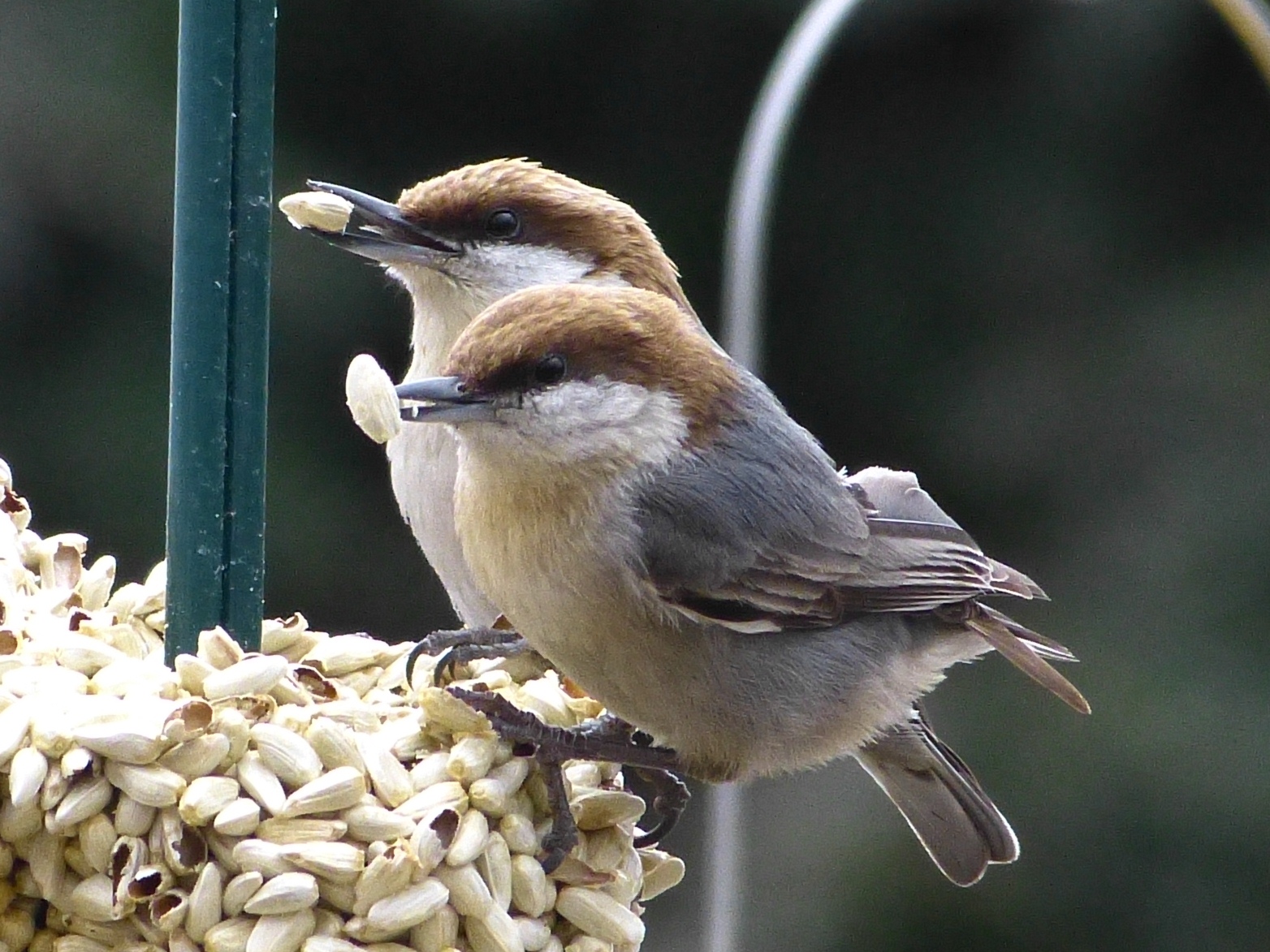
No, these particular birds were not my life Forsyth County Brown-headed Nuthatches, but you weren't going to keep reading without some cute photos, were you?

No, these particular birds were not my life Forsyth County Brown-headed Nuthatches, but you weren’t going to keep reading without some cute photos, were you?

County birding is my favorite of games birders play, but it took a while before I got serious.  In December 2009, eBird introduced county birding to “inspire people to go birding in places that don’t typically get much coverage.”  I am a huge fan of eBird, so I wanted to help with this effort.  I started birding the counties adjacent to Forsyth that didn’t have many checklists.  Sometimes I went alone, but frequently I enlisted friends Carol or Brent to go with me.  We had great fun on our outings and it wasn’t long until Carol and I found a county record Horned Grebe for Stokes County.  It was the first time that anyone had reported the species in that county.

In the County Birding "game," an American Robin counts just as much as a rare bird.

In the County Birding “game,” an American Robin counts just as much as a rare bird.

At some point I became aware that county birding was more than an eBird effort; it was almost a competitive sport.  I discovered that birders in Texas, Florida, California, and a few other states were obsessed with focused on county birding.  And then I met Derek, right here in Forsyth County, who had seen birds in all of North Carolina’s counties.  I started joining him occasionally for a day of birding as he upped his county ticks.  County ticks are simply the sum of one’s life lists for each county in an area (usually a state).  So, if I had seen 200 birds in Forsyth County and 100 birds in Guilford County, I would have 300 county ticks for NC.  It didn’t take many days of birding with Derek until I decided that I, too, wanted to see birds in all of North Carolina’s counties.

Cynthia and I spent a day with this Golden-winged Warbler in Watauga County

Cynthia and I spent a day with this Golden-winged Warbler in Watauga County

I also birded with other friends whenever I had a chance.  One of my favorite county birds was the gorgeous Golden-winged Warbler in the photo above.  My good friend, Cynthia, wrote a guest post on this blog, Golden-winged Wonders, about our experiences with “Andy.”

I am especially grateful for my friend, David, and my son-in-law, Jeff.  David is not a birder, but he understood my craziness and helped me in the western part of the state.  It can be hard to find birds in those small mountainous counties and I was happy to have the company and the help.  Jeff is only a casual birder, but he spent several days with me in the northeast corner of the state searching for birds.

A pretty Hermit Thrush that Jeff and I found in Chowan County.

A pretty Hermit Thrush that Jeff and I found in Chowan County.

I wish that I’d kept notes on every outing, every new milestone, but I did not.  Instead, I have only delightful random memories, like a stream of consciousness.  Please indulge me as I share a few of those memories.

Derek is an excellent birder with the energy that comes from being young.  And, he was willing to go birding with me – a woman with bad eyesight and old enough to be his grandmother.  The love of birds and birding that transcends all other differences is one of the things that I love about the birding community.  But, I digress.

A lovely Cedar Waxwing found on the Bakersville Creek Walk in Mitchell County

A lovely Cedar Waxwing found on the Bakersville Creek Walk in Mitchell County

A typical day of birding with Derek started with meeting around 7:00 AM and driving two to three hours to get to the counties we needed.  Derek is a great planner and he continued to watch bird alerts while I drove.  We birded until dark and then Derek drove on the way home.  Sometimes it was 11:00 PM when I pulled into my driveway.  But, we always had fun and we always got new county birds.

In January 2017, Derek introduced me to the idea of combining county birding and state birding, seeking birds not just new to a particular county, but new for the state.  A rare (for North Carolina) Anna’s Hummingbird had turned up on the coast, inspiring us to make a two-day trip to see this beauty.  We added several new birds for Dare County, including a surprise Brown Thrasher while waiting in line at the Nags Head KFC drive-thru.

The Anna's Hummingbird that Derek and I drove to the NC coast to see

The Anna’s Hummingbird that Derek and I drove to the NC coast to see

Later that year in May, we couldn’t miss an opportunity to see this cooperative Mourning Warbler in Avery County, another state bird for both Derek and me.  This led to stops in Wilkes County, an Alder Flycatcher at a blink-and-you-would-have-missed-it bog on the Blue Ridge Parkway in Burke, and then multiple stops at under-birded hotspots in Mitchell, Yancey, and McDowell counties.  Our favorite location that we discovered that day was the lovely Bakersville Creek Walk in Mitchell County, which I made into an eBird hotspot.

Our lovely Mourning Warbler on the Blue Ridge Parkway in Avery County

Our lovely Mourning Warbler on the Blue Ridge Parkway in Avery County

In addition to finding notable birds, I enjoyed the quirkiness and little surprises of county birding.  Derek and I called it the “wavy road.”  It was as much in the middle of nowhere as any place in NC.  I think we were on a mission to find a Clay-colored Sparrow.  The road was completely level on the middle line, but the edges rose and fell like waves.  Driving the road felt like a ride at an amusement park.  We marveled at the oddity of the road and were happy that it didn’t last too long.  And, yes, we got our bird.

On a day of birding with Hop in Cleveland County, he pished up this Golden-crowned Kinglet.

On a day of birding with Hop in Cleveland County, he pished up this Golden-crowned Kinglet.

Plenty of mistakes were made in my search for new birds, mostly when I was birding alone.  I currently have only one bird for Halifax County even though I spent the night there.  I got confused about the county line and did not even realize where I was!  A more serious mistake occurred when I was birding alone in the Croatan National Forest and became totally lost.  Fortunately, I was able to use the eBird track on my phone to navigate back to my car.  Once on a trip with Derek to the Sandhills area in the middle of summer, I failed to take water on our walk.  When we were almost back to the car, I began to feel sick – very hot and nauseous – so I just laid down on the sand and sent Derek back to the ranger station.  I knew the ranger would come for me in his truck, which he did, and I learned a very valuable lesson.

This young Brown-headed Cowbird appeared to be hot, too, on that sweltering day in Cumberland County.

This young Brown-headed Cowbird appeared to be hot, too, on that sweltering day in Cumberland County.

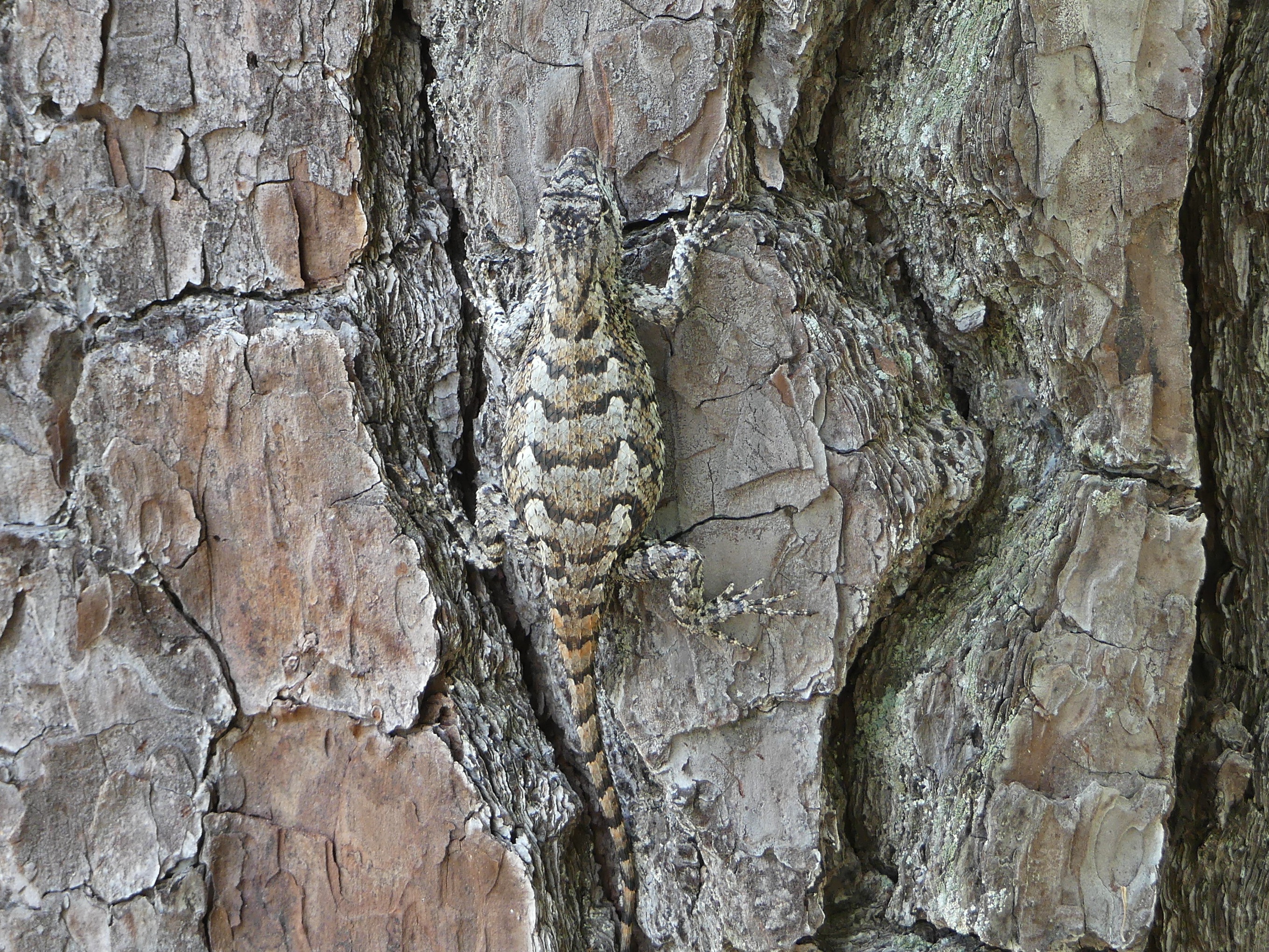
But, the heat might have been responsible for the wonderful lizards we also found on that hot July day.  Derek and I considered all wildlife sightings a big bonus of county birding.

Eastern Fence Lizard at Carvers Creek State Park, a lifer lizard for me!

Eastern Fence Lizard at Carvers Creek State Park, a lifer lizard for me!

I made even more mistakes finding birds, again usually when I went out on my own.  Many these errors were my poor decisions about which birding hotspots to visit.  A State Recreation Area on a large lake was “Closed for the Season” when I got there in the middle of winter.  Some hotspots no longer had access and some were just about impossible to find.  One location with many great eBird reports appeared to be a road that no one would walk except hunters or crazy young male birders.  I’m pretty brave, but I was not going to park my car on the side of the road and walk alone into the wilderness in a remote, isolated part of the state.

A Great Spangled Fritillary that Derek and I found near Boone in June 2016. We frequently encountered beautiful butterflies while searching for birds.

A Great Spangled Fritillary that Derek and I found near Boone in June 2016. We frequently encountered beautiful butterflies while searching for birds.

As I have written this, more memories keep flooding back.  Looking for Swallow-tailed Kites with Nathan and Sarah.  The Person County Northern Lapwing with David S.  The Brown Booby with Jay.  The Allen’s Hummingbird with Phil and Carol C.  Transylvania County.  Forsyth Audubon and Piedmont Bird Club trips.  I can’t name them all, but I treasure every one of my birding adventures and I am grateful to have shared so many with friends.

My most recently photographed county tick is this Tricolored Heron, right here in Forsyth County, only the second of this species to be observed in our county.  But, I now have an even newer county bird, a Royal Tern that David Disher found at Salem Lake during Hurricane Florence.

My Forsyth County Tricolored Heron

My Forsyth County Tricolored Heron

My eBird map for NC is below.  As you can see, I don’t have many birds in most counties, so I’ll be able to continue the county birding game for quite a while as I add new birds.  I hope to keep birding in North Carolina for a very long time.

Read Full Post »

Florida always calls to me in winter.  Especially this year, as I really wanted a break from the unusually cold weather we are having in North Carolina.

The only prep I did for this year’s trip was to sign up for the Space Coast Birding Festival, so imagine my surprise when I checked eBird my first night on the road.  THREE Ruffs were currently being seen in Alachua County, Florida.  And, two of them were in the Home Depot retention pond that was not a mile from Liz’s house!  I took this as a sign that the birding gods would favor me on this trip.

The male Ruff in Gainesville. With the wind blowing his neck feathers up, you get a hint of what he will look like in breeding plumage.

The male Ruff in Gainesville. With the wind blowing his neck feathers up, you get a hint of what he will look like in breeding plumage.

For my non-birding friends, Ruffs are shorebirds.  You might even call them boring when they are not in breeding plumage (and we rarely see them in breeding plumage here in the US), but they are rare and birders love rare birds.  Previously, I had seen only one Ruff in 10 years of birding, which I wrote about in A Smooth Trip for a Ruff.

With the Ruffs waiting for me in Florida, I got on the road early the next morning.  I got to Gainesville around noon and went directly to Home Depot.  It could not have been easier.  I walked over to the pond and immediately found both Ruffs, a male and a female, and shot some photos.  Birding mission accomplished, I then went to visit with my step-daughter, Liz, and my two granddaughters, Quinn and Casey.

Next it was south to Dunedin for a couple of days with my friends, David and Val.  Another rare bird awaited me near their house, 10 of them actually.  For the last two years, Brown Boobies, seabirds of tropical waters, have wintered in the unusual location of upper Tampa Bay.  David and I went in search of the boobies and found 6 of them roosting on towers in the bay shortly before dark.

The boobies were too far out for good photos, but a pair of Greater Scaup swam close by the pier at Safety Harbor. This pretty bird is the female.

The boobies were too far out for good photos, but a pair of Greater Scaup swam close by the pier at Safety Harbor. This pretty bird is the female.

The next day we went to Possum Branch, one of our favorite local birding spots.  We heard lots of Yellow-rumped Warbler chips as usual, but suddenly one higher pitched chip stood out.  We stopped and looked hard for the little bird.  David finally found an olive-colored warbler with a grayish head that looked like it had been dipped in a a light wash of yellow.  I was never able to get my eyes on that bird, but the next morning my luck would change.  David headed to work and I left for my drive to the east coast.  But, first I went to Kapok Park, another of our favorite spots.  I heard the chips again and this time I saw several of the plain little birds, which I could now confirm as Orange-crowned Warblers.  I was very happy that I even got a photo.

Orange-crowned Warbler at Kapok Park

Orange-crowned Warbler at Kapok Park

My warbler story may sound boring, but I hope not.  For what is more important, not just in birding, but in life, than the little joys of new discoveries, the sweetness of finding unexpected beauty in plainness?  All made sweeter when shared with a friend.  Life birds are great, but these magic moments are what I live for.

My next four days were filled with gulls.  I had signed up for almost all the gull field trips and workshops that the festival offered.  That’s a lot of gulls even for a normal birder, but I wanted to learn all that I could.  On Wednesday, we started with a trip to the Cocoa Landfill.  After a short introduction to the workings of the landfill, we headed out to look for birds.  We saw Laughing, Ring-billed, Herring, Lesser Black-backed, and Bonaparte’s Gulls.

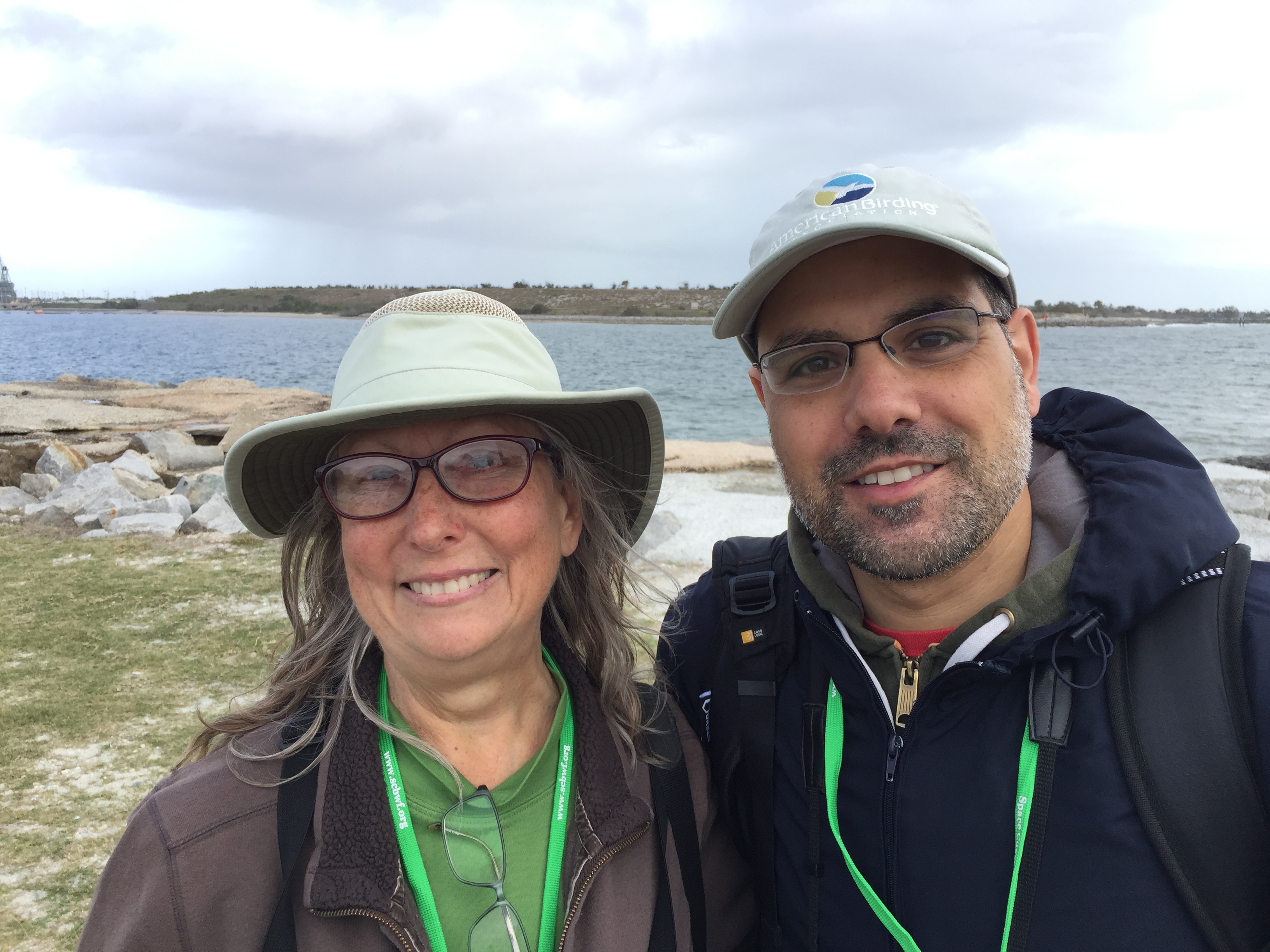
Amar Ayyash and me

Amar Ayyash and me

I was signed up for the “Gull Fly-In” at 3:30 that afternoon, but Amar Ayyash, one of the trip leaders, said that he was going early and that I was welcome to go with him.  We grabbed a quick drive-thru lunch and ate in the car as we headed to Frank Rendon Park at Daytona Beach Shores.  This particular stretch of beach is popular with wintering gulls.  It has been estimated that as many as 50,000 gulls sometimes roost on the beach.  They come in big numbers late in the afternoon for a few hours before heading offshore for the night, but at 1:00 PM, there were enough birds to keep us busy.  Amar quickly found all the expected species – everything we had seen at the landfill plus Great Black-backed Gull – as well as a couple of hybrid candidates.  I tried to soak in all the information that I could, but, as a beginner, I was overwhelmed.  I took as many photos as possible for later study.

This bird has a ring on its bill, so it's a Ring-billed Gull, right? Nope, it's a Herring Gull. Most of those common field marks only apply to adults. This bird is an "adult type," probably a 4th cycle bird.

This bird has a ring on its bill, so it’s a Ring-billed Gull, right? Nope, it’s a Herring Gull. Most common field marks only apply to adults. This bird is an “adult type,” probably a 4th cycle bird, but not yet fully mature.


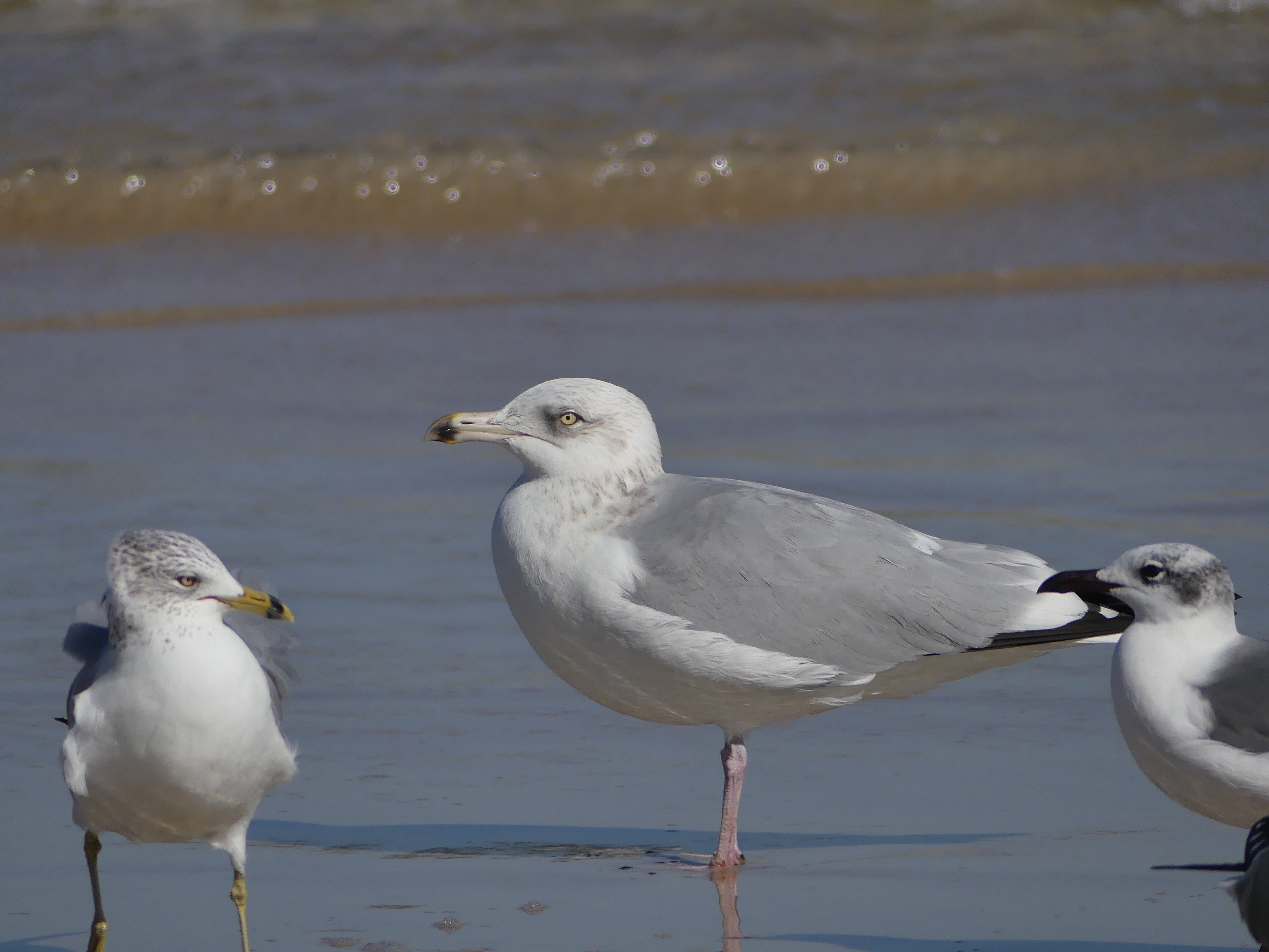
Hmm. What's this bird with the dark tip to its bill? Yep, another "adult type" Herring Gull. The smaller bird to the left is an adult Ring-billed Gull.

Hmm. What’s this bird with the dark tip to its bill? Yep, another “adult type” Herring Gull. The smaller bird to the left is an adult Ring-billed Gull.


A 1st cycle Great Black-backed Gull. We saw quite a few of these beautiful birds. I love the clean, crisp pattern.

A 1st cycle Great Black-backed Gull. We saw quite a few of these beautiful birds. I love the clean, crisp pattern.


This big, beautiful young gull is probably a Glaucous x Herring Gull hybrid, frequently called "Nelson's Gull."

This big, beautiful young gull is probably a Glaucous x Herring Gull hybrid, frequently called “Nelson’s Gull.”

And, all of this was before the official festival field trip even began!  After we were joined by Michael Brothers, Florida’s leading gull expert, and the 30 to 40 festival participants, we continued walking on the beach, sometimes only about 20 feet from the birds, until 6:00 PM.  We saw literally thousands of Laughing and Ring-billed Gulls and good numbers of the other species, too.  We added Iceland Gull to our list with two individuals.  A few appear in Florida most winters, but they are unusual enough to be considered rare.

Iceland Gull at Daytona Beach Shores, Florida, January 24, 2018

Iceland Gull at Daytona Beach Shores, Florida, January 24, 2018

The next morning, it was back to the Cocoa Landfill.  I considered skipping a second trip to the same location, but I woke up early and decided that it would be a good chance to study the Lesser Black-backed Gulls that we had seen on the first day.  After the talk about the landfill, we went to the area where everything was covered with a black tarp and water had collected on top.  There was a little shallow pool at one end and the others walked down there to see the Bonaparte’s Gulls.  I had seen them the day before, so I stayed put, fiddling with my camera, when Chris Brown, one of our guides, came to get me.  “Shelley, I think you will want to see this.”  As I hurried to where the others had gathered, the bird with a red bill immediately caught my eye.  “OMG, it’s a Black-headed Gull,” I squealed, delighted to finally see this species in the US.  And, this was a beautiful bird, a healthy-looking adult, giving us a much closer view than I’d ever had in China.

Black-headed Gull, Cocoa Landfill, January 25, 2018

Black-headed Gull, Cocoa Landfill, January 25, 2018

I enjoyed the rest of the festival, especially Amar’s gull identification workshop.  Amar is a living encyclopedia of knowledge about gulls and my goal is to learn enough that I can follow his discussions on the Facebook group, “North American Gulls” and his blog Anything Larus.

The last field trip that I’d signed up for was to Jetty Park at Cape Canaveral on Saturday morning.  The trip leaders were Amar, Jeff Gordon, and Greg Miller, one of the birders featured in the book and movie “The Big Year.”  While waiting for everyone to arrive, Greg and I quickly discovered that we are distant cousins.  It was fun to meet Greg and I’m looking forward to future discussions about our shared ancestors.

Greg Miller and me at Jetty Park, Cape Canaveral

Greg Miller and me at Jetty Park, Cape Canaveral

Jeff Gordon reminded me that he was a birding guide before he was ABA President when I casually asked if we might see any Northern Gannets and a few minutes later he pulled in a gorgeous adult nice and close.  I had seen thousands of them in NC, but this was a new Florida bird.  I never get tired of watching these beautiful birds plunge headfirst into the water.

Our leaders that morning were alert to anything interesting and found this Portuguese Man o’ War washed up on the beach. They are not really jellyfish, but the closely-related siphonophore, a colony of individuals.

Portuguese Man o' War

Portuguese Man o’ War

Jetty Park was the end of the festival for me.  The time with Amar had significantly improved my gull knowledge and ID skills and I enjoyed seeing old friends and making new ones.  But, my time in Florida was not quite up yet.

What's a trip to Florida without a Loggerhead Shrike? I observed this bird at Viera Wetlands calling and singing almost continuously.

What’s a trip to Florida without a Loggerhead Shrike? I observed this bird at Viera Wetlands calling and singing almost continuously.

My friend Kerry was in Florida for the winter and we had made arrangements to go birding after the festival.  I had asked Kerry for her target list of birds that she wanted to see and she listed just one – Snail Kite.  I suggested that we go to Three Lakes WMA and then Joe Overstreet Road and the little marina on Lake Kissimmee.  The night before we would meet, I was getting tired and I began to worry.  What if we didn’t see anything at Three Lakes?  What if we missed the Snail Kite?  I thought about changing our plan to include more opportunities to find Snail Kite and I fell asleep worrying.

Perhaps I dreamed of eagles. Kerry and I would see five Bald Eagles the next day.

Perhaps I dreamed of eagles. Kerry and I would see five Bald Eagles the next day.

A night’s sleep must have refreshed me.  I awoke feeling much more optimistic and decided to stick with our plan.  It wasn’t long after our arrival at Three Lakes that we started seeing birds.  Shortly after we started down the main road, we both caught a glimpse of something light in a distant clump of trees.  I thought caracara and Kerry thought eagle.  A moment later we saw an eagle fly out.  And, then we saw something in the trees again – there WAS a caracara!  But, Kerry saw another bird, too.  We got out the scope and discovered an eagle perched about 10 feet from the caracara.  What was a young Crested Caracara doing with two adult Bald Eagles?  It was too far for a photo, but I’m sure we will both remember our fascinating raptor sighting.

We kept seeing more birds – Eastern Towhees so close that we could see their white eyes (our North Carolina towhees have dark eyes), oodles of beautiful Pine Warblers, an Orange-crowned Warbler, Purple Gallinules, and many more species.

My photo is poor, but our looks at the Snail Kite were great.

My photo is poor, but our looks at the Snail Kite were great.

We had such a great time birding at Three Lakes that it was after noon when we got to Joe Overstreet Road.  We slowly drove the five miles to the marina, parked the car, and walked to the little pier.  Kerry was ahead of me and before I caught up with her, I heard something like, “There’s the Snail Kite.  Oh, there are two of them.”  We enjoyed the show for about an hour, with great looks at the kites as they hunted for snails, occasionally flying just 20 feet in front of us.

I had not needed to worry.  We ended the day with 60 species, a life bird for Kerry, and memories of a beautiful day that neither of us will forget.

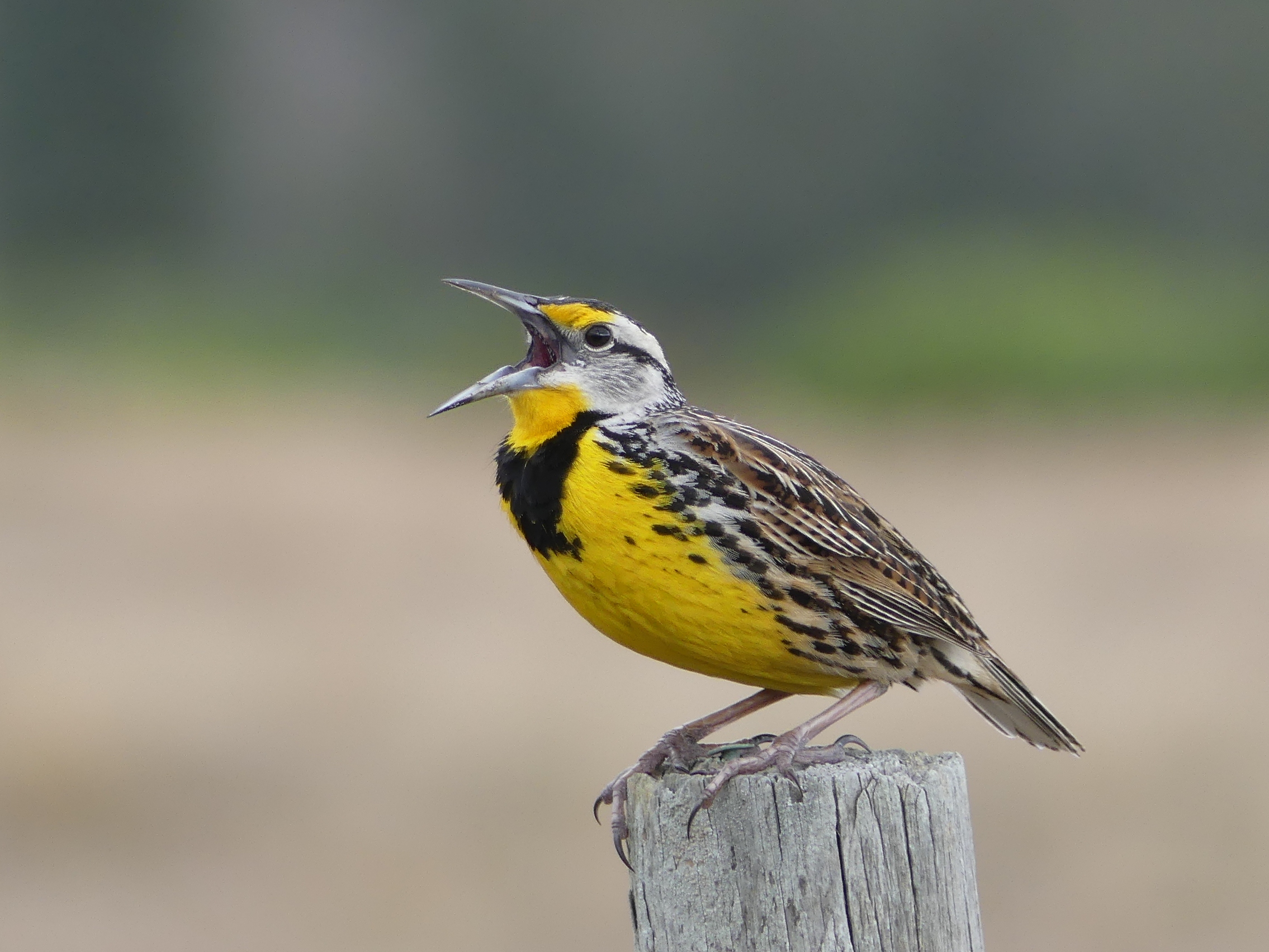
This gorgeous Eastern Meadowlark sat on a fence post outside our car window on Joe Overstreet Road and sang almost non-stop. He was still singing as we finally pulled away and continued down the road.

This gorgeous Eastern Meadowlark sat on a fence post outside our car window on Joe Overstreet Road and sang almost non-stop. He was still singing as we finally pulled away and continued down the road.

It was another great trip to Florida.  More photos will be posted to Flickr soon.  My photos of birds are also on eBird and can be seen here.

Read Full Post »

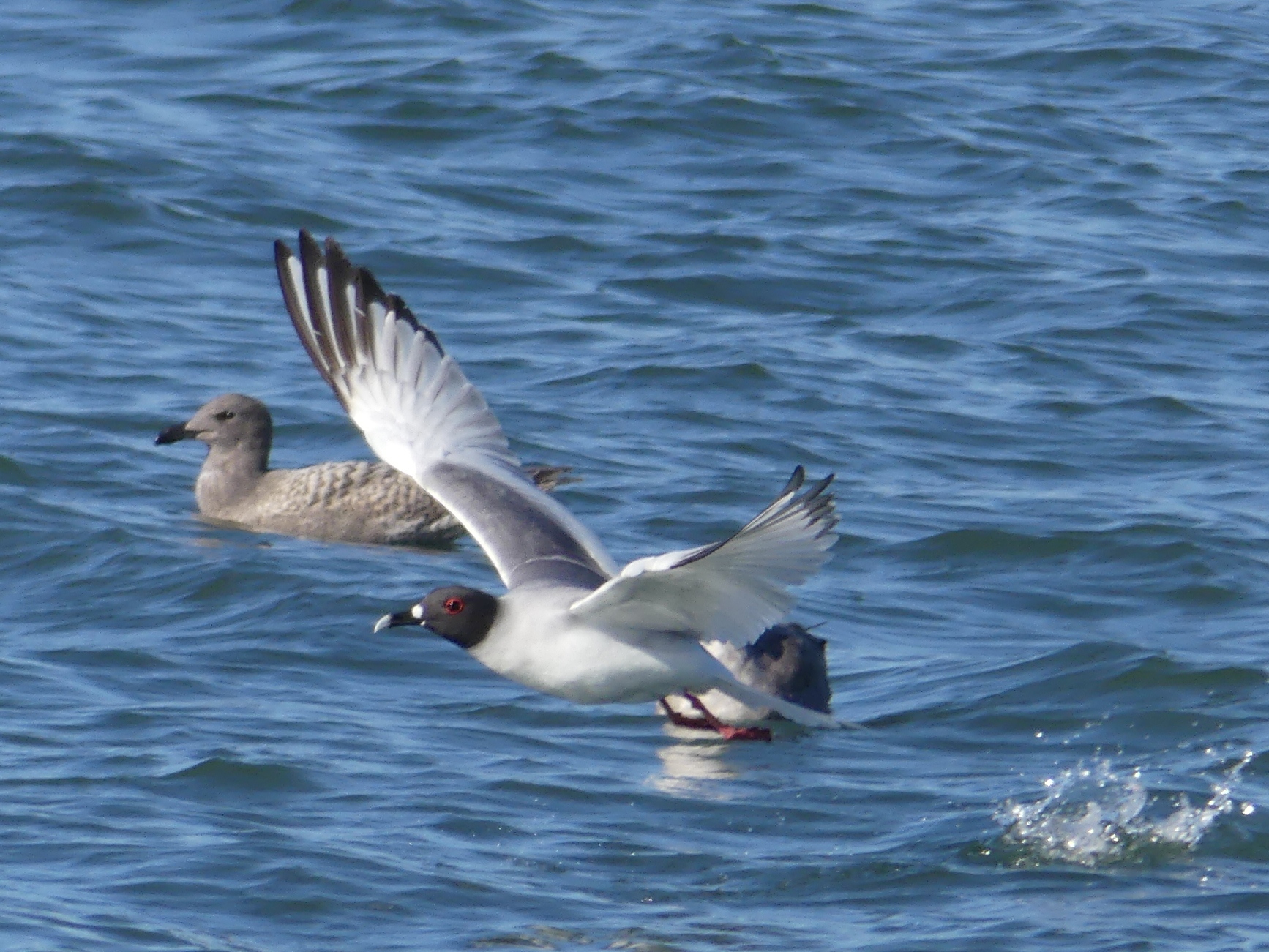
Huge liquid black eyes encircled by thick red rings. Light-tipped black bill with perfect white spots at the base. Black hood, red legs and lovely black-tipped wings. And, the tail – the gorgeous white u-shaped tail. The Swallow-tailed Gull is widely considered to be the most beautiful gull on earth. Never in a million years would I have expected to see this bird on my trip to Washington, but let me start at the beginning.

Those big beautiful eyes facilitate hunting at night. Swallow-tailed Gulls are the only nocturnal gulls in the world.

Those big beautiful eyes facilitate hunting at night. Swallow-tailed Gulls are the only nocturnal gulls in the world.

My friends Phil and Mary Dickinson moved across the country from North Carolina to Washington in December 2015.  I expected very few life birds in Washington, but I wanted to visit my friends and I thought that it would be fun to see the Pacific Northwest and a new state.  Phil suggested that late August/early September would have nice weather, so I flew to Seattle on August 28.

On our first full day, Phil took me to Big Four Ice Caves where I got my first life bird of the trip, Black Swift. I also had an introduction to the beautiful Washington landscape.

The beautiful but dangerous ice caves. Phil and I heeded the warnings to stay on the trail, but many did not. There have been four deaths here since 1998.

The beautiful but dangerous ice caves. Phil and I heeded the warnings to stay on the trail, but many did not. There have been four deaths there since 1998.


Fireweed at Big Four is beautiful even when past its prime.

Fireweed at Big Four is beautiful even when past its prime.

The next day, Phil, Mary, and I drove to Mount Rainier National Park.  We took our time with a stop for a picnic lunch and walk at Federation Forest State Park.  We arrived at Crystal Mountain Resort mid-afternoon and had a nice dinner after acquainting ourselves with the Sunrise area of the park where we would be spending our time.

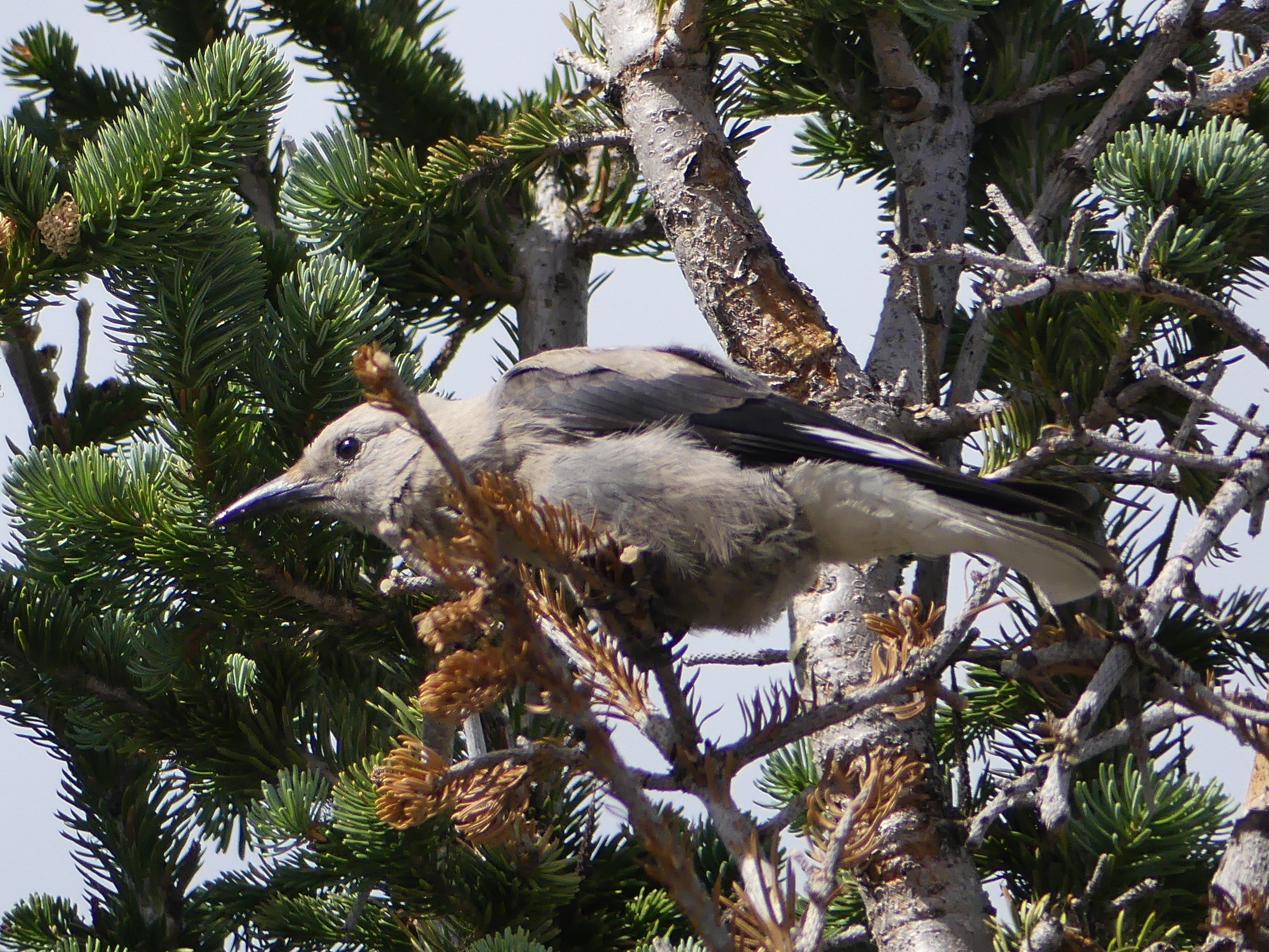
A Clark's Nutcracker greeted us in the Sunrise Visitor's Center parking lot.

A Clark’s Nutcracker greeted us in the Sunrise Visitor’s Center parking lot.

The following morning, Phil met some birders from home in the parking lot just before we started our hike.  They mentioned that a Swallow-tailed Gull had been found early that morning in north Seattle.  I received a text from a friend in North Carolina also notifying us of the gull.  What?  A Swallow-tailed Gull is a pelagic bird of the southern hemisphere that comes to land only to nest, mainly on the Galapagos Islands.  Other times of the year, it cruises the off-shore waters of South America’s Pacific coast from Colombia to Chile.  A Swallow-tailed Gull has been seen in North America only twice before, and in California, not nearly so far north.  This was a mega-rarity!  Some crazed birders would have abandoned plans for Mt. Rainier and sacrificed the advance payments we had made for our rooms that night to chase this bird.  We didn’t consider that option and hoped that the bird would stick around until we got back home.

A Yellow Pine Chipmunk posed near the Sunrise Visitor's Center.

A Yellow Pine Chipmunk posed near the Sunrise Visitor’s Center.

One of our target birds on the Mount Freemont Lookout Trail was Prairie Falcon, which had been seen there the previous day.  The three of us walked the first mile and a half of the trail, which was labeled “moderate,” before Mary turned back.  Phil and I continued on the “strenuous” trail for another 1.3 miles and I soon became scared.  Parts of the trail were just a narrow scree path with an abrupt steep drop-off for hundreds of feet down the side of the mountain.  Phil was kind, patient and encouraging as I slowly conquered my fears and made my way.  Finally, we reached the lookout where we found raptors in the distance, but they turned out to be Red-tailed Hawks.  However, Mountain Goats, a Pika, and a feeling of accomplishment rewarded our efforts.

Phil and I conquered Mt. Fremont.

Phil and I conquered Mt. Fremont.

On Friday morning, Phil and I went out to look for birds before breakfast.  We drove to the campground and kept a sharp eye out for grouse on the side of the road, but we did not see any.  We decided to check the trail at Sunrise Point, where we were rewarded with a Red-breasted Nuthatch loudly calling as soon as we opened the car doors.  We started down the trail and had not gone more than a few yards when Phil said, “Shelley, there’s your grouse.”  And, there it was on the side of the trail walking towards us.  A Sooty Grouse – life bird #2 for the trip!  We continued to watch the grouse, an adult male, for 10 minutes as he kept an eye on us, but foraged very close by.  Finally, we decided that it was time to go have breakfast with Mary.

This male Sage Grouse was waiting for us at Sunrise Point.

This male Sage Grouse was waiting for us at Sunrise Point.

But, our wonderful, birdy morning was not quite over yet.  About a mile from Sunrise Point, Phil spied a woodpecker flying across the road and quickly stopped the car.  And, then we saw a second bird and quickly realized that it was a pair of American Three-toed Woodpeckers, a species that each of us had only seen once before.

The yellow crown on this American Three-toed Woodpecker isn't visible in this photo, but you can clearly see that he has only three toes. Except for the Three-toed and Black-backed, all North American woodpeckers have four toes.

The yellow crown on this American Three-toed Woodpecker isn’t visible in this photo, but you can clearly see that he has only three toes. Except for the Three-toed and Black-backed, all North American woodpeckers have four toes.

The three of us had a good breakfast and then started the drive home.  We had been watching the local birding listserv, Tweeters, and the Western Washington Birders Facebook group for updates on the Swallow-tailed Gull, but as of mid-afternoon, it had not been re-sighted.  We started to think that it might be a “one day wonder.”  Finally, in the late afternoon, it was found a few miles north of the original location.  Reports said that this new location was very difficult to access and required a dangerous and possibly illegal trek across active railroad tracks to get a good look.  We hoped that the bird would stay a third day.

Western Sandpipers foraged at the Everett Sewage Lagoons, some in deeper water up to their bellies. Occasionally a bird would submerge its head completely under water.

Western Sandpipers foraged at the Everett Sewage Lagoons, some in deeper water up to their bellies. Occasionally a bird would submerge its head completely under water.

On Saturday morning, Phil and I went birding in his home county.  Again, we watched for news of the gull and were ready for the chase if it was found.  We mostly birded coastal areas with a foray to the sewage treatment plant in the middle of the day.  After a quick drive-thru at Burger King for a very late lunch, we drove to the Everett marina on the Puget Sound, mainly because we didn’t have time to go anywhere else.  I had wanted to get good looks at California Gulls, which are common there.  They were there as expected, but one gull was different.  We both felt absolute disbelief as we realized that we had found the Swallow-tailed Gull.

The gull showed off its swallowtail while preening.

The gull showed off its swallowtail while preening.

Phil got the word out that we had found the gull and 10 minutes later other birders started arriving.  We continued to watch the gull in close waters, happy with our good views, when the impossible happened.  The Swallow-tailed Gull flew right in front of us on the two-foot wide strip of dirt between the parking lot and the water, no more than 20 feet away.  We had incredible looks at the bird at it stretched its wings and picked at pebbles.  After a few minutes, a truck drove by and the gulls flew back into the water.

Courtship includes the male offering the female pebbles for the nest. Hmm. Does this beauty want to make more Swallow-tailed Gulls?

Courtship includes the male offering the female pebbles for the nest. Hmm. Does this beauty want to make more Swallow-tailed Gulls?

I then turned my attention to the small group of birders who had shared this amazing experience with us.  I heard someone say that a guy had flown in from Chicago.  I introduced myself and the man replied that his name was Amar Ayyash.  I don’t know of anyone in North American who knows gulls better or loves them more.  If I could have chosen any person in the world to share this experience with it would have been Amar.  This gull was a super star and it had also drawn Shawneen Finnegan and Dave Irons from Portland, Oregon.  Alex Sundvall had flown in from Minnesota.  I’m sure there were others from out of state, too, but it wasn’t possible to meet the 80 or so birders who were there when we left.  Others had already come and gone and more would arrive after we went home to celebrate with Mary.

A close-up of the amazing Swallow-tailed Gull in breeding plumage. Outside breeding season, the head is white and the eye ring is black.

A close-up of the amazing Swallow-tailed Gull in breeding plumage. Outside breeding season, the head is white and the eye ring is black.

As I write this, the Swallow-tailed Gull is still being seen in Edmonds, about 15 miles south of where Phil and I discovered it.  This is day 10.  Will it stay longer?  Perhaps.  Squid, the gull’s primary food, has been plentiful in the area.

An "Oregon" Dark-eyed Junco cooled off on a hot day in the Dickinson bath while we relaxed on the deck.

An “Oregon” Dark-eyed Junco cooled off on a hot day in the Dickinson bath while we relaxed on the deck.

Phil and I had some pleasant birding for the next two and a half days, but I did not get any additional life birds.  Regardless, it was fun to see some of his local birding locations and enjoy the birds in his backyard.  Spending time with friends, seeing spectacular landscape of the Pacific Northwest, and the thrill of finding a rare bird will keep memories of this trip sharp in my mind for a very long time.

Phil’s story, Beauty and a Surprise Highlight Washington Birding, is on the Forsyth Audubon blog.  For another fun story and amazing photos, see Amar’s post,  Swallow-tailed Gull Twitch, on his blog, Anything Larus.  More of my photos are on Flickr in the Swallow-tailed Gull album and Washington – 2017.

Read Full Post »

Birders don’t call these games, but consider the following activities.

Life List

The most basic birding game is simply keeping a list of all the birds that you have ever seen anywhere.  Not much beats the thrill of seeing a bird for the very first time, so this game is played by nearly all birders everywhere.  I clearly remember foolishly wondering, shortly after starting my life list, what I would do after I had seen all the birds possible in nearby locations. And, then I learned about all the other birding games.

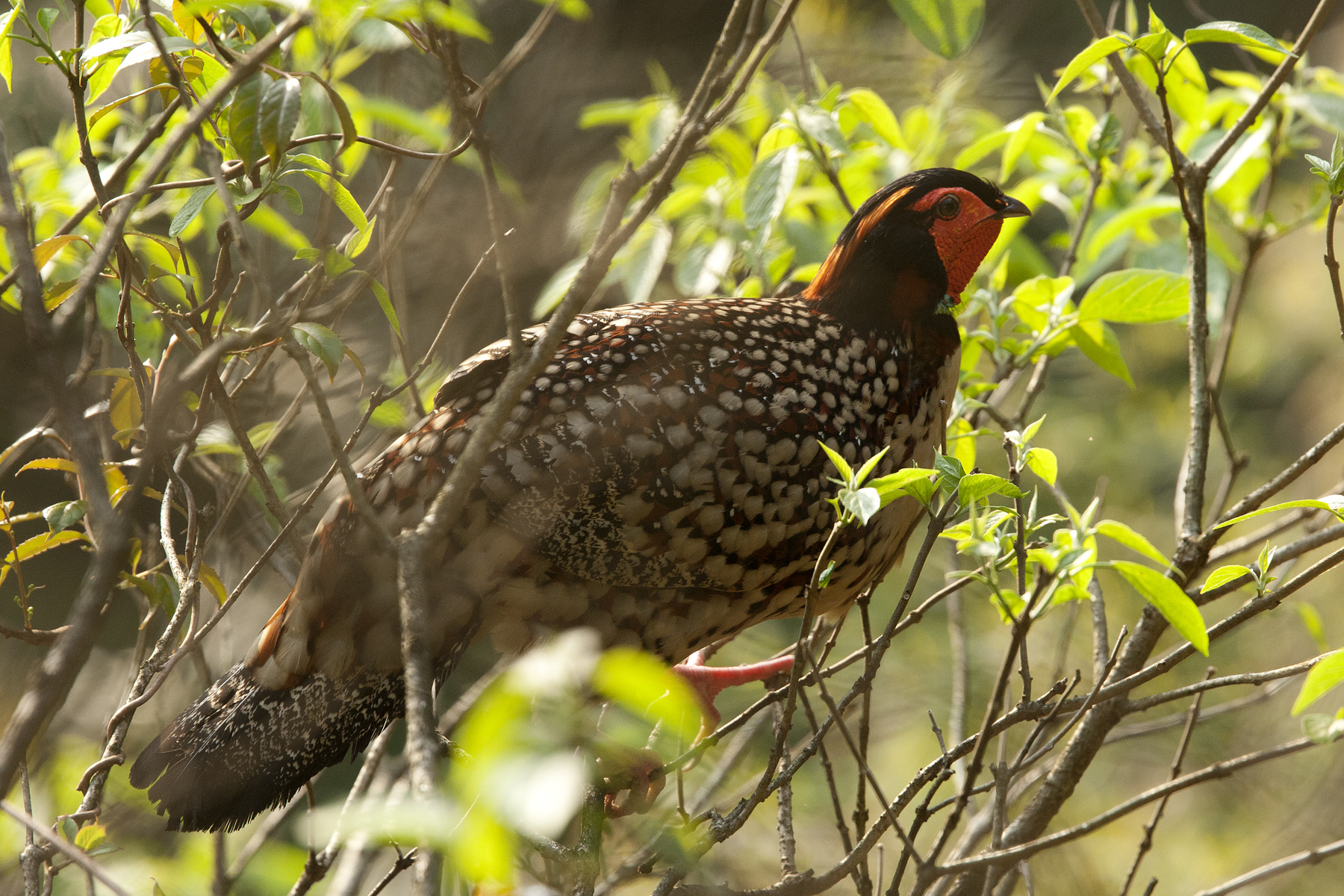
Cabot's Tragopan on my 2012 China trip. One of my favorite birds ever! Photo by Tony Mills.

Cabot’s Tragopan on my 2012 China trip. One of my favorite birds ever! Photo by Tony Mills.

State List

Many birders keep a list of all the birds that they have seen in a particular state, usually the state in which they live.  This activity usually involves actively “chasing” rare birds that appear anywhere in the state in order to increase one’s state list.

County List

This activity is similar to State List, but for just one county, usually the location of one’s residence.  Even more so than with State List, birders will cancel other plans, call in sick to work, or do whatever is necessary to see any new bird that shows up in their county.

Bad photo, but great bird - the first Whimbrel ever observed in Forsyth County.

Bad photo, but great bird – the first Whimbrel ever observed in Forsyth County.

ABA List

Some birders put the most importance on their ABA list, birds observed in the ABA (American Birding Association) Area, most simply defined as North America north of Mexico.  For some, their ABA list has a higher priority than their life list.  Birders who are obsessed interested in their ABA List may fly across the country to see birds already seen elsewhere just to get them on this list.

Other geographic areas

Any geographic area that you can name can be the target for a birding list – Ecuador, China, Asia, the Western Hemisphere, the Lower 48 (US states) – the possibilities are nearly endless.

Blue-winged Mountain-Tanager in Ecuador.

Blue-winged Mountain-Tanager in Ecuador.

Big Year (ABA Area)

Until recently “Big Year” meant ABA Big Year. This is the game that was made into a book and a movie, “The Big Year.”  It told the story of three men obsessed with “winning” the most birds in 1998.  People have mortgaged their homes to pursue this activity. It also requires tremendous effort and the stamina to endure heat, cold, loss of sleep, and other discomforts. In spite of these challenges, the majority of us who do not have the time, money, and endurance to play this game have fantasized about it.

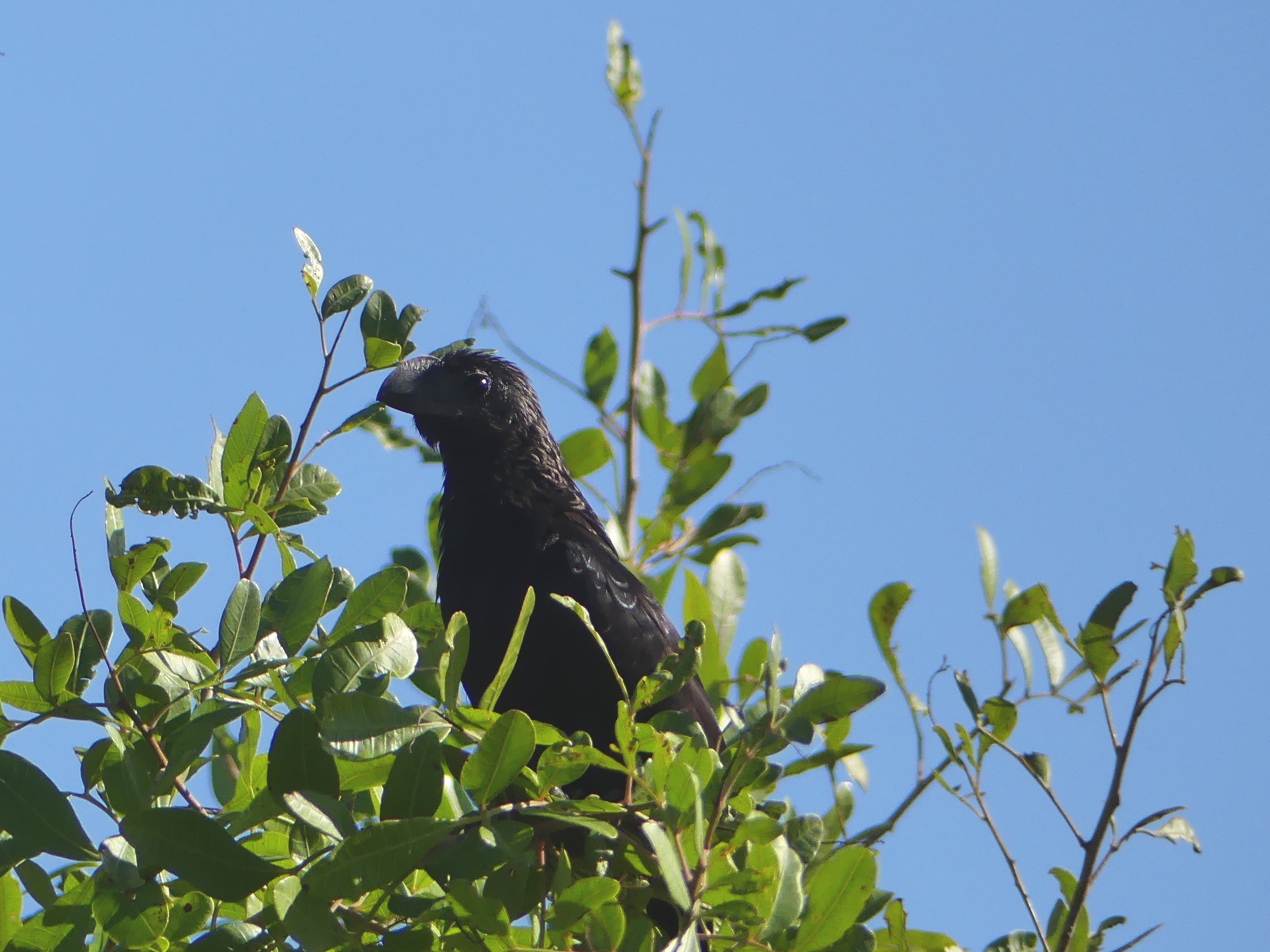
If I were doing a Big Year in 2017, this Smooth-billed Ani seen in Florida would be a good start.

If I were doing a Big Year in 2017, this Smooth-billed Ani seen in Florida would be a good start.

Big World Year

This is now the ultimate game – how many birds can you see in one calendar year with the entire planet as the playing field. In 2008, British couple Alan Davies and Ruth Miller traveled around the world attempting to see 4,000 species. They completed the year with 4,341 species and wrote a book about their adventure, The Biggest Twitch. In 2015, Noah Strycker set out to see half the world’s species, approximately 5,000 birds. He also met his goal and set the new world record with 6,042 bird species. Noah’s record was immediately challenged by Dutch birder Arjan Dwarshuis in 2016. He finished the year with 6,833 bird species.

The closest I'll ever get to a world big year was in 2014 when I went to both China and Belize, where I saw this Great Kiskadee.

The closest I’ll ever get to a world big year was in 2014 when I went to both China and Belize, where I saw this Great Kiskadee.

Big State Year and various location/year combinations

Where I live, Forsyth County (NC) Year List is a popular game, although I don’t know anyone who will admit to playing it. However, about a dozen birders go birding nearly every day. They make it a point to see species that require special effort like American Woodcock, a bird that is usually seen only in particular places at dusk.  If anyone else finds a “good” bird (i.e. uncommon for our area), they will go look for it. I keep trying to break my addiction to this game, but so far I’ve been unsuccessful. And, I’m not sure that I really want to quit. We have the friendliest birding community that I know of anywhere. We don’t compete with each other and everyone is quick to share the news when they find a good bird.

The adult male Anna's Hummingbird in Buxton - a nice addition to my 2017 NC list.

The adult male Anna’s Hummingbird in Buxton – a nice addition to my 2017 NC list.

Want to read more about Big Year birding? There is even a Wikipedia article called Big Year.  The American Birding Association (ABA) outlines the official listing rules at Listing Central and displays the numbers that ABA members have reported.  All of these birding games are made easier by using eBird, which automatically maintains many of these lists for you as well as providing alerts for “needs” and rare birds.
County Birding

This is a little different than the basic County List because it focuses on finding birds in ALL the counties in a state. One common version is 100 birds in every county. In Maryland, which has only 23 counties, they play 200 birds in every county.

50 Birds in 50 States

I have friends who are working on these lists – to see 50 species in each of the 50 US states.  What a great way to see the country!

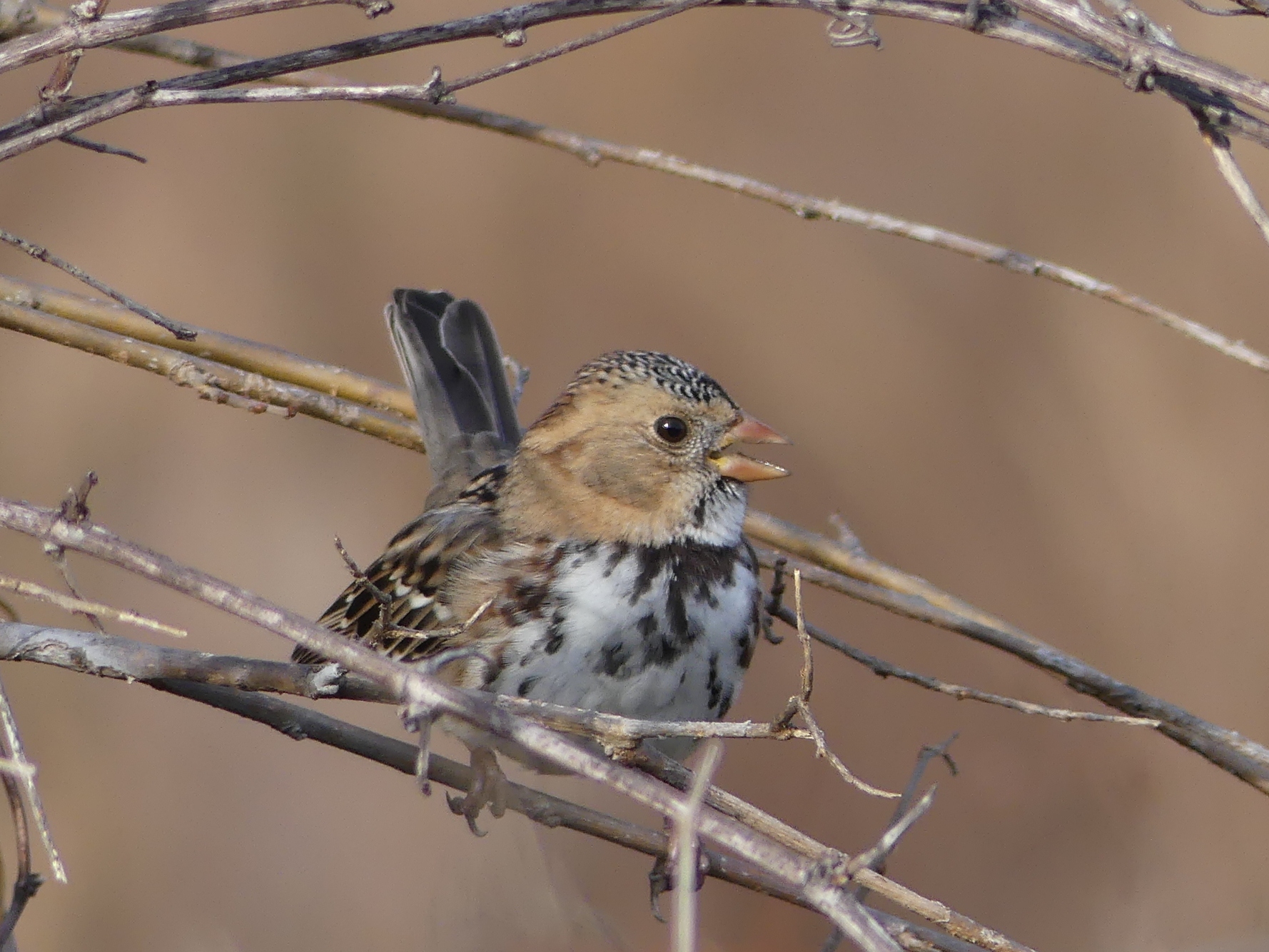
I don't have 50 birds in Iowa yet, but this young Harris's Sparrow got my list off to a good start.

I don’t have 50 birds in Iowa yet, but this young Harris’s Sparrow got my list off to a good start.

Bird-A-Day

Bird-A-Day is a twist in which one records a different species observed every day for as many days as possible throughout the year.  In 2016, I made it through half the year recording my last new bird on July 1.  I swore that I would not do it again, but here I am deep into it in late February 2017 and plotting how I can beat last year’s attempt.

Photographed Birds

Any of the above games, but only birds that you photograph count.

Great Crested Flycatcher. One of my favorite photos.

Great Crested Flycatcher. One of my favorite photos.

Birders are creative and I’m astounded by the new things that I am learning every day. Day List? Yes, some people even keep lists for each calendar day of birds seen in any location, in any year, but on that specific day.  This list of lists could go on and on, but I’ll quit now and leave it up to you to find more or even invent your own birding game.  I’ve got to go look for a Woodcock now.

Read Full Post »

« Newer Posts