David flew home on Monday morning, June 12. I was tired after all the adventures of last few weeks, so I took it easy the rest of the day and revisited Custer State Park. This time I stopped and walked around beautiful Sylvan Lake.

I enjoyed the walk even though I did not see a lot of wildlife other than a few families of Canada Geese on the lake with their adorable goslings.

Next, I drove the 18-mile wildlife loop road again. eBird lists 167 species for this hotspot, but I reported only 15 species that day. I believe that I would have seen more if I had started earlier in the day and been more familiar with all the trails and side roads. Regardless, I was happy to have another visit to Custer State Park. I saw a few birds, Common Ringlet butterflies, and some interesting plants, mostly on the Prairie Trail.
Do you remember Scott Rager from my last post? I had met Scott at the LAK Reservoir near Newcastle on the day that I drove from Deadwood to Edgemont. I find most birders to be friendly and generous, but Scott was exceptional. He offered to spend an entire day with me, so we met on Tuesday morning. We started at Ruby Canyon, where I had unsuccessfully searched for Virginia’s Warbler in 2018. Scott had seen Virginia’s there recently and he got a quick look again with me, but I wasn’t fast enough to see the bird. We spent a long time at the watering trough, but the much-wanted warbler did not show up. The Chipping Sparrows loved the water, though, as did a pair of Black-headed Grosbeaks.

Roby Canyon was the only location during the trip where I saw the gorgeous Weidemeyer’s Admiral, a new butterfly for me.

After a delicious lunch at a local Mexican restaurant, we birded a few areas near Newcastle. We added several common Western species to my list and a “rare” (flagged as such by eBird) Eastern Phoebe, normally a more Eastern species, that Scott had found earlier in the breeding season. I had started the day with 45 Wyoming birds and had 60 by the time we headed to Scott’s place as dusk approached. As we sat watching the feeders and chatting, it seemed that we were too late to see a Lewis’s Woodpecker. Then, just before dark, this stunning bird came in for a late dinner. Scott sometimes has half a dozen of these gorgeous birds in his yard, but I was thrilled with just this one. I’ve never had better looks and it was a wonderful end to a great day.

The next morning I got a little later start than I’d wanted and I had to go to the grocery store. The hotel I would be staying at that night had suggested that I bring food as there was none available there. Later in the day I would regret the delay, but by day 19 of a trip I am not my most efficient. So, I headed south and after a quick spin through Lusk Cemetery (Orchard Oriole, Wyoming #63), I was in Nebraska.
The drive to Henry Road was a bit longer than I had expected and I arrived at 11:12 AM. Henry Road is a dirt road on open range and I did not see another person the entire time I was there. I did not see a lot of birds either, but this location is popular among birders for the prized species that do occur. I saw Horned Larks on the fence wires and in the road, a common bird in the West and not my target.

The avian stars of Henry Road are the longspurs – Chestnut-collared and Thick-billed.

I did not get great photos of either longspur as I’d hoped, but these are special birds, and it’s always a treat to see them. Sadly, their range is quickly shrinking. Just a few years ago, they were regularly found in Thunder Basin National Grasslands, where I had been a few days earlier, but none were reported in Weston County (Wyoming) this year.

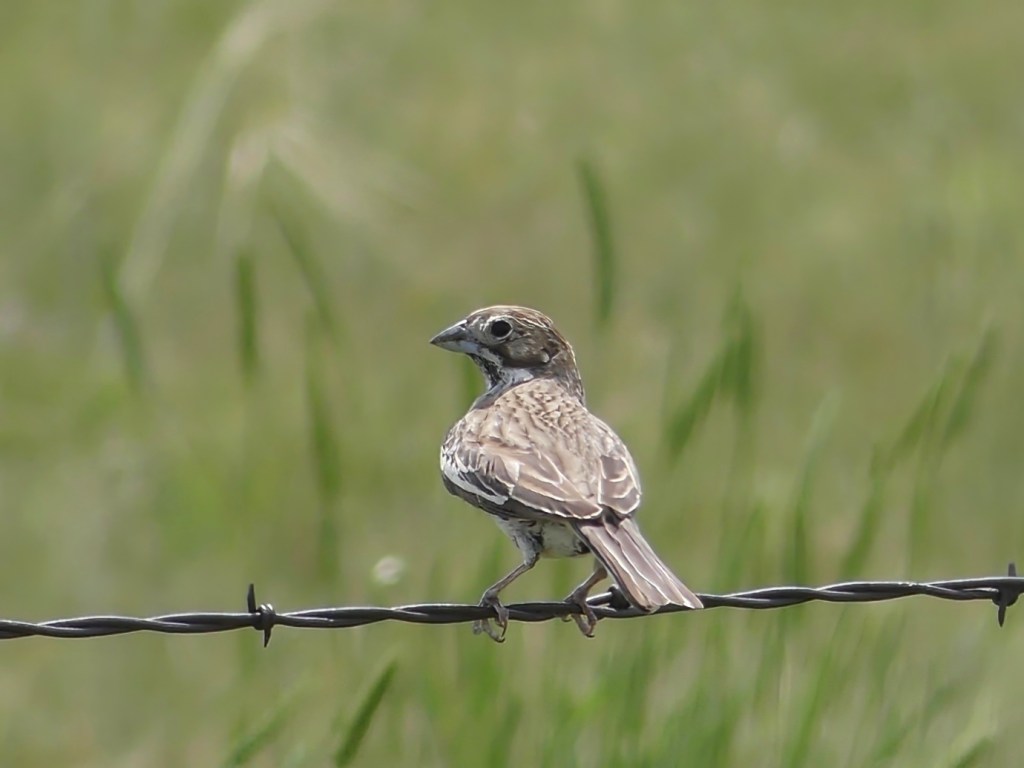
I also saw quite a few Lark Buntings. Below, a female or immature bird, which looks so different from the adult male.
Another treat was a singing Brewer’s Sparrow.

I spent over 3 hours on Henry Road, much longer than I had intended, and my exit was delayed even more by these cows. There was a cattle guard between my car and the cows and fences on both the right and left sides of the road. The only way out was where those cows were standing. They were oblivious to my horn and just did not want to budge. Once again, I’m sure my friends worry about all the wrong things on my solo road trips. Who would have guessed that a herd of cows would hold me hostage? After much slow and tedious effort, I was able to get through an inch at a time. Literally, those cows would back up only one small step when I slowly crept forward.

Finally, I was back on the highway and drove towards the little town of Lakeside. From there, I turned south towards Crescent Lake NWR for 28 miles on a once-paved road now just crumbling asphalt, dirt, and rocks. I didn’t mind the road at all; my only regret was getting there so late that I could not spend hours and stop as often as I wanted to soak in the beauty. It was amazing and my words are inadequate to convey the awe I felt as Long-billed Curlews and Willets flew overhead calling.

American Avocets, the color of dreamsicles as a friend once described them, Wilson’s Phalaropes, and multiple species of ducks foraged in the little ponds.

I saw several Upland Sandpipers. I am pretty sure that this one and another that was with it are “teenagers.”

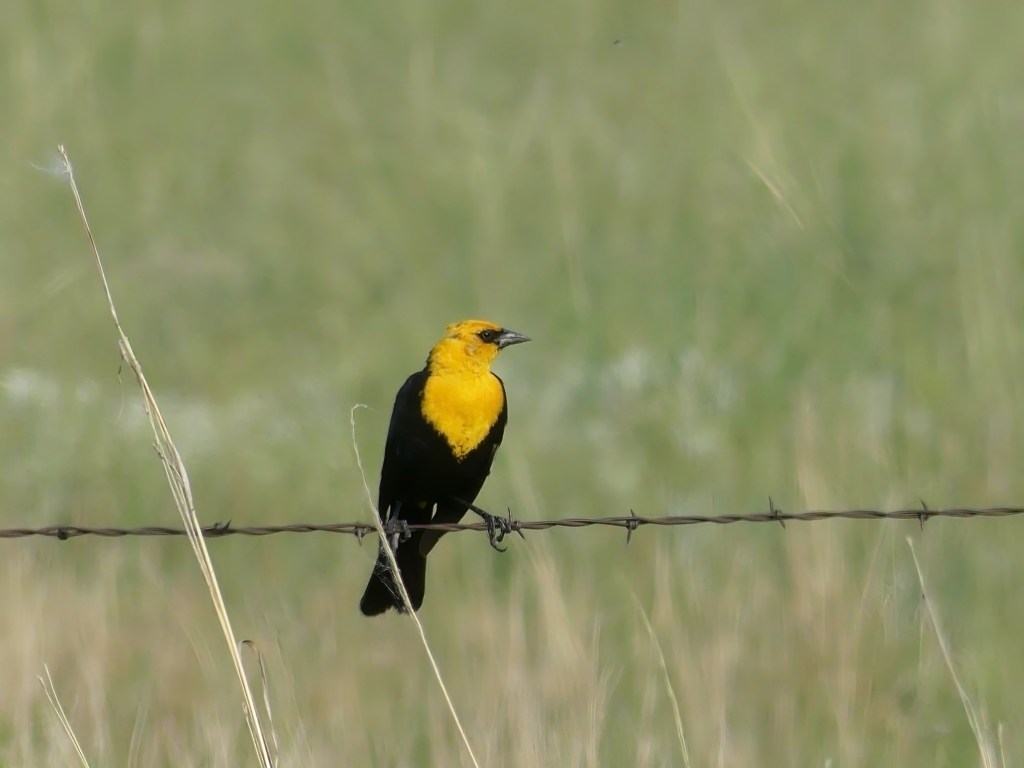
Yellow-headed Blackbirds are one of my favorites.
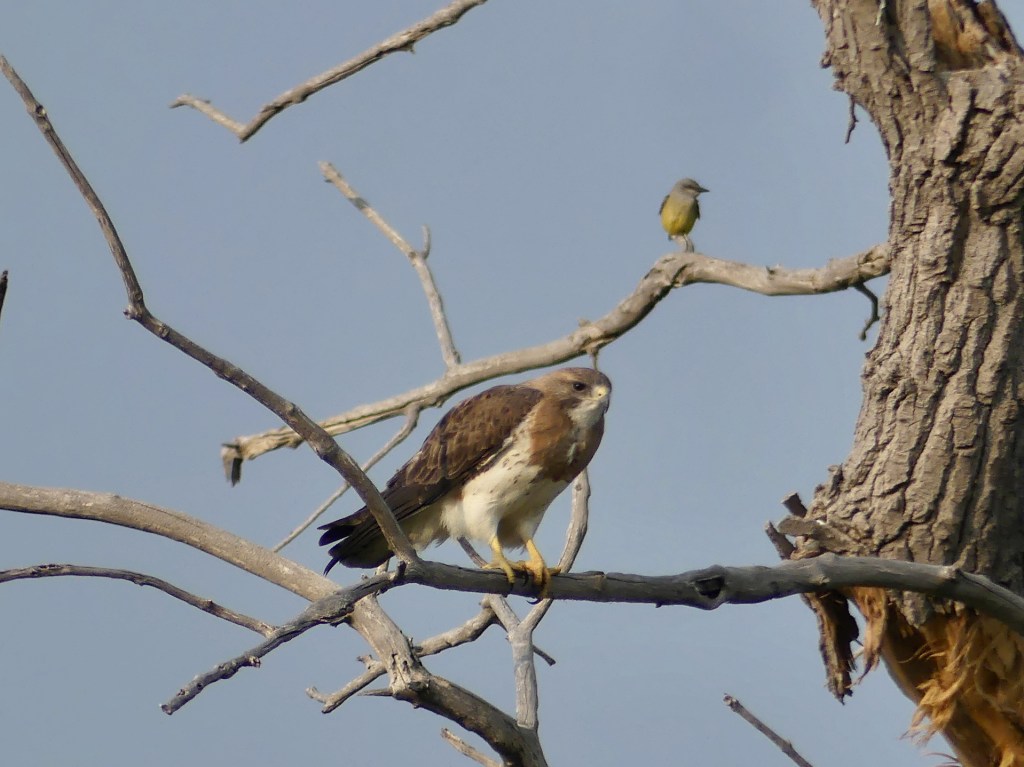
I can’t leave out a Swainson’s Hawk on any story about a trip west. This one came with a bonus Western Kingbird.
This pretty Ornate Box Turtle was also on the road to Crescent Lake NWR.

Because of my poor time management earlier in the day, I had only 2-1/2 hours on this incredible road. This is my favorite kind of birding and I’m now inspired to do a “dirt and gravel road” trip out west.
All that was left after this wonderful day was the long, tedious drive home. I didn’t have quite as much ambition for county birding and iNat as I had on the long drive at the start of the trip. I put in some effort, though, and was rewarded with a Giant Walkingstick at a McDonald’s drive-thru window in Oklahoma.
I accidentally reset my trip meter, but I’m pretty sure that I drove about 6,250 miles on this trip. It was a lot of time behind the wheel, but the rewards were worth it.




 Birding for Life