After last year’s “birdless” birding and biking trip, I was thrilled when my friend, David, suggested South Dakota in June. That is not a slam against Utah, which was amazing, but March was not the birdiest time of the year to be there. South Dakota would not give me many life birds, if any at all, but it would have abundant bird life in June. While I was birding, David would survey the beautiful scenery of the Black Hills from his bicycle during RASDak (Ride Across South Dakota). Below, a preview of the beauty awaiting us.

I left my home in Florida on May 26 and headed first to northwest Iowa. Each big road trip now begins and ends with three long days of driving. Those three days are tiring, but the monotony is relieved by birding at stops along the way. Two White-winged Doves calling at a rest stop in Madison County, Florida, were unusual enough to be flagged as rare by eBird. It was fun to find a singing White-eyed Vireo and an Orchard Oriole behind a Shell gas station in Tupelo, Mississippi. An Indigo Bunting at a roadside rest area in Arkansas was a new state bird (#57). Once I hit Iowa, every rest area hosted singing Warbling Vireos.
Iowa also had one of the prettiest rest areas that I have ever seen. This gorgeous mural at the entrance to the women’s restroom couldn’t help but relieve road weariness.

Finding interesting things for iNaturalist also helped. I liked this pretty Foxglove Beardtongue at a gas station in Missouri.

Finally, I arrived in Haywarden, Iowa, on the evening of May 28. Two Common Nighthawks flew around the hotel and surrounding fields as I unpacked my car. They stayed just a couple of feet from each other and I loved watching and hearing them off and on for nearly an hour.
My friend, Eric Harrold, met me at the hotel the next morning and we set off with the goal of getting my Iowa bird list to 50 species. Eric’s birding skills and local knowledge quickly got my Iowa list to 59 species and we headed north to Minnesota. We enjoyed chatting over lunch at JJ’s Tasty Drive In in Luverne where my friend, Diane, joined us. Her husband had driven her down from Mayer (a small town west of Minneapolis) and she would spend the next few days with me.

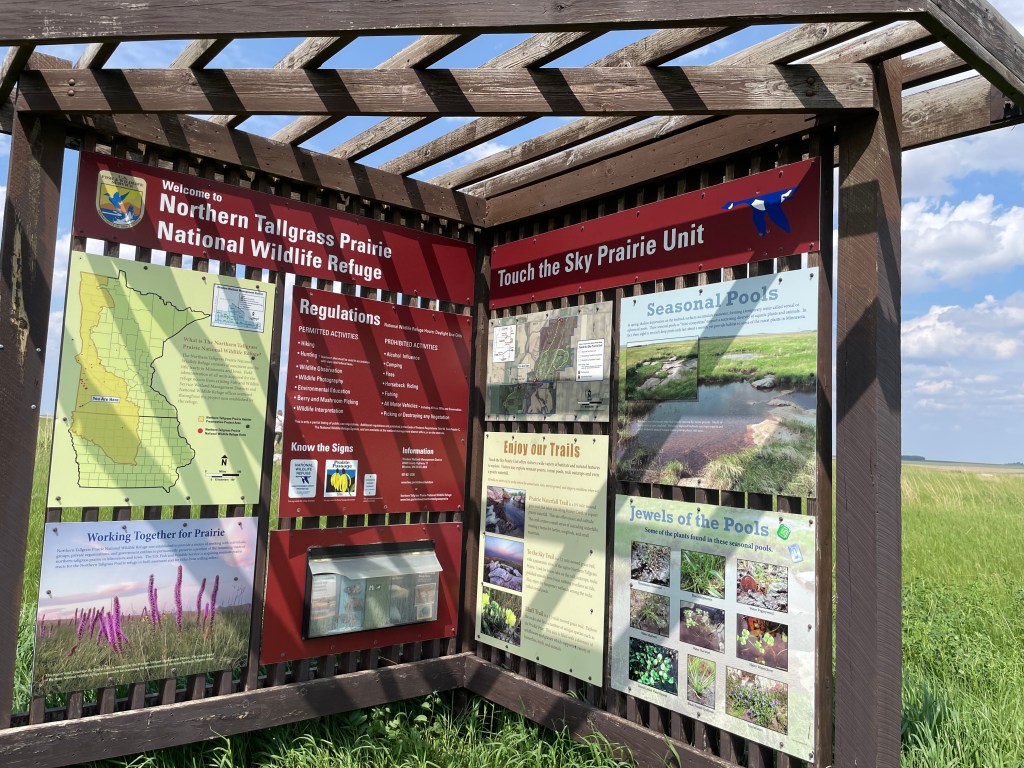
The first afternoon stop for the three of us was Blue Mounds State Park. It’s a nice park, but did not have anything notable on this particular day, so we checked out the nearby Touch The Sky Prairie unit of the Northern Tallgrass Prairie National Wildlife Refuge. We all immediately fell in love with this 1,000-acre segment of a rare native ecosystem. And, it’s the ecosystem itself – how the grasses, wildflowers, and birds are interconnected – that makes this place so peaceful and captivating. All of us want to visit this inspiring prairie again.
Diane and Eric (and Eric’s dogs) on the prairie trail.

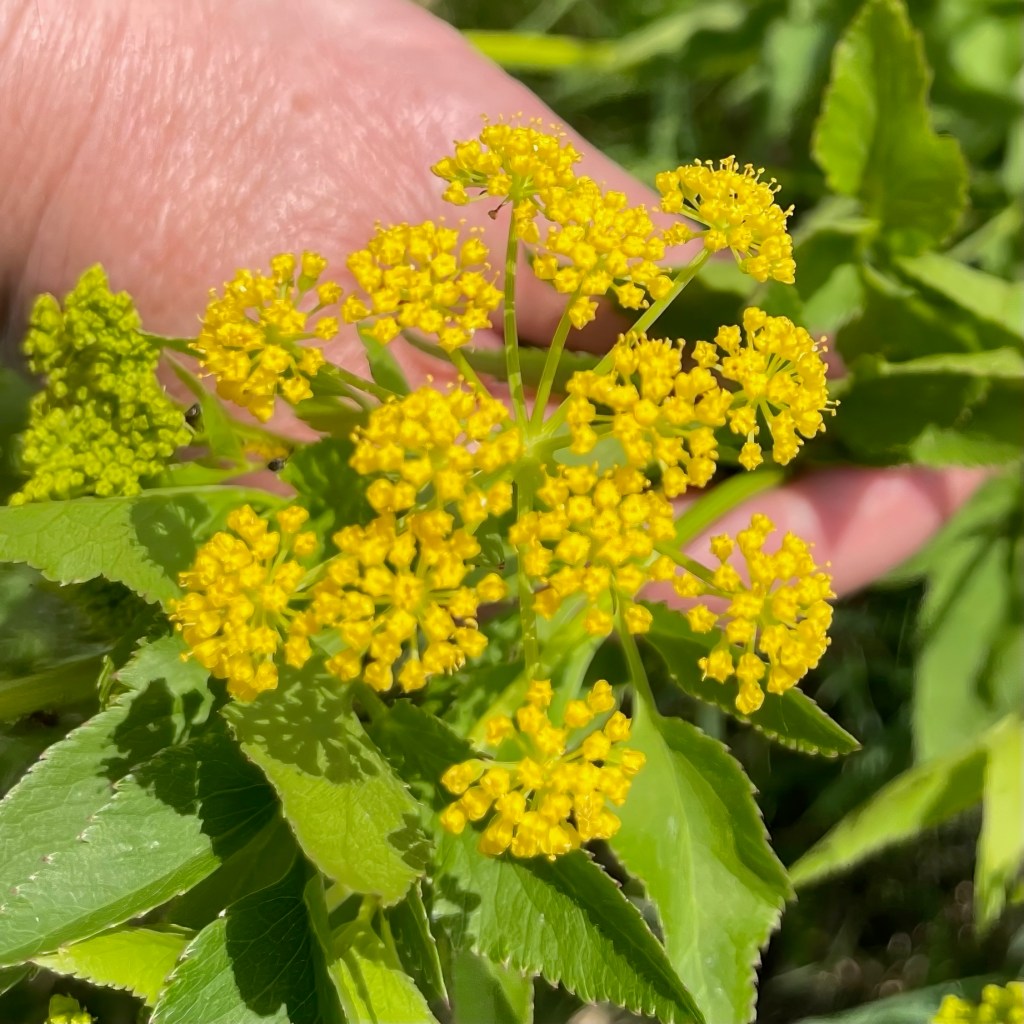
Wildflower season was just beginning. Below, a pretty Prairie Violet and Golden Alexanders.

The highlights of the day were the many singing Dickcissels and Bobolinks. I’ve never had better, closer views of these species and I love seeing birds thrive on their breeding grounds.


Finally, we had to say goodbye to Eric after a wonderful day together. Diane and I returned to a different part of Blue Mounds SP for another short visit. Soon, the prairie called us back and we visited Touch The Sky one more time late that afternoon to indulge our fascination with the cooperative Bobolinks and Dickcissels and take more photos.


Prairies covered nearly a third of North America before European settlers began plowing in the 1860’s. Today significantly less than half of the historical area remains intact. Tallgrass prairies have suffered the greatest losses due to their higher rainfall and rich soils which makes the land productive for growing wheat and corn. As a result, tallgrass prairie is now one of the most endangered ecosystems in the world.
Estimates for the remaining area of tallgrass prairie vary from less than 1% to 18% of its original range. Many threatened or endangered species depend upon these remaining patchy areas for their continued survival. Audubon’s 2019 North American Grasslands and Birds Report lists Henslow’s Sparrow, Bobolink, Greater Prairie-Chicken, Northern Bobwhite, Vesper Sparrow, and Eastern Meadowlark at risk in tallgrass prairie. These species have already suffered huge population losses in the last 50-60 years, from 37% for Vesper Sparrow to an astounding 97% for Greater Prairie-Chicken. Farther west in mixed grass prairie, Lesser Prairie-Chicken is on the verge of extinction.
To learn more about the complex and fascinating prairie ecosystem, see this brief overview of Kansas’s tallgrass prairie. More excellent info is on the Minnesota Prairie pages of the MN Department of Natural Resources.
Continue to part 2 about this trip, Road Trip 2023: Days 5-7 – The Badlands! (Part 2 of 4)





 Birding for Life