Feeds:
Posts
Comments

Posts Tagged ‘Florida’

American Oystercatcher

American Oystercatcher at the Dunedin Causeway

“Shelley, look, there’s your Oystershucker!” I fondly remembered finding my life American Oystercatcher with my friend, David, in St. Pete as I flew there on March 2. David and I had a day and a half to bird together before he would drive me to meet my son-in-law, Jeff. David is not a real birder and that’s why I love birding with him. We once watched a Great Blue Heron try to eat a fish for half an hour. If I had been with a “real birder”, I’d have been embarrassed to pay so much attention to a common bird. This time we watched three Mourning Doves for 15 minutes. While field guides don’t show differences between males and females, we were sure that the grayer bird was a male and the browner ones were females. The male showed a patch of glowing iridescence on the side of his neck as he puffed himself up and strutted towards the females. We thought that they would mate right in front of us and prove who was who, but picking for food in the grass won their interest. A little research after the trip revealed that there IS a difference between male and female Mourning Doves which Bill Hilton describes and illustrates with gorgeous photos MOURNING DOVE: EXTERNAL ATTRIBUTES OF A FAVORITE GAME BIRD.
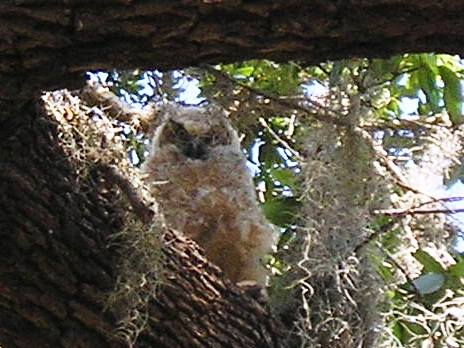
Great Horned Owl

Great Horned Owl

Saturday we visited Kapok Park, where we saw both Great Horned owlets and mom. The owlets were big “branchers” now and out of the nest, fuzzy and adorable. Great Horned Owls have nested at Kapok for several years. The photo at left was taken by David in 2009.

Sunday dawned so windy that we had to change our plans for morning birding. Instead of looking for Marsh and Sedge Wrens, we decided to drive the Dunedin causeway to look at shorebirds (much to David’s relief, I suspect). We enjoyed quite a few birds including our favorite Oystercatcher, but I was most excited to realize that I could confidently identify winter-plumaged Red Knots. All the shorebird study was paying off!

On Monday, Jeff and I drove to Miami to look for White-crowned Pigeons and countable exotics. We headed to a location in the middle of Miami where two pigeons had been reported on utility wires. Sure enough, we surveyed the area for 15 minutes and a White-crowned Pigeon appeared right in front of us just as we here about to leave. Life bird #1 for the trip!

Jeff’s friend, Tom Trotta, joined us for a day in the Everglades on Tuesday. Tom is President of Friends of the Florida Panther Refuge and Jeff is a volunteer with this wonderful organization. Our target bird was Short-tailed Hawk, which we failed to find, but it was a pleasant day that started with a Scissor-tailed Flycatcher and produced another White-crowned Pigeon. It was much more satisfying to find a pigeon hidden in a clump of trees eating pigeon berries than to see one on a utility wire. The shy bird was well hidden, but we clearly saw was its face, white iris, and white crown. This was how birding should be.

Another highlight was finding Stilt Sandpipers. I immediately suspected that’s what we had when I saw two birds the size of Lesser Yellowlegs completely submerging their heads under water while feeding. Close scope views confirmed the field marks – a long black bill slightly drooped at the tip, the prominent white eyebrow. It was a life bird for Jeff and Tom and I was thrilled that I could make the ID. I could be the poster child for Doug and Bob’s Shorebird Workshop. “Shelley attended our workshop and now she can identify a winter-plumaged Stilt Sandpiper. You, too, can learn this birding feat!”

After another couple of pleasant days birding, it was time to head back to the St. Pete airport. We had time for one quick stop on my last day and we decided to try for the Short-tailed Hawk at St. Pete’s Sawgrass Lake Park, where they have bred in previous years. Before we reached the first observation area, a man called us over to see a Limpkin that has just eaten a snail. While watching the Limpkin, an Osprey plunged into the water 20 feet in front of us and flew off with the fish he caught. We looked up and saw a Short-tailed Hawk circling with nesting material. Life bird #2! It was a great week, but I have more birds to find in Florida. I remembered my late husband’s advice to “save something for next time.”

Read Full Post »

January 2012

Tricolored Heron at Merritt Island NWR

The moon has completed a full revolution around Earth since my last day of work and I haven’t even begun cleaning up my house.  But I have seen 149 species of birds, including 5 life birds.

January 3, the first workday of the year, was bitterly cold, but I felt an irresistible urge to get out of the house.  I drove around a bit and as I returned home, I saw dozens of both Black and Turkey Vultures patrolling my neighborhood and roosting in a backyard pine tree three houses down the street from my house.  I stopped my car in front of a neighbor’s house and stood in the street staring in amazement as the vultures flew low over the street.  My neighbor came out to ask what I was watching.  We talked a bit about the birds as we enjoyed the unusual sight.  Just as she walked back to her door, I screamed “Bald Eagle, Bald Eagle!” and she came running back.  I shared my binoculars and we watched an adult eagle fly over our heads.  This was the first time that I had met this neighbor, yet we jumped up and down and hugged like excited children.  She told me that she had seen the eagle perched in a tree in her backyard earlier that day, but did not know what it was.

My planned Florida trip was postponed at the last minute due to unexpected events, but my birthday was January 12 and I wanted to celebrate with birds.  On an impulse, I signed up for the Georgia Ornithological Society meeting in Tybee Beach, Georgia.  The trip got off to a wonderful start with a stop at Savannah NWR on the way to the meeting.  Three other birders were in the parking area when I arrived and we all birded the wildlife drive together.  Our sightings included a King Rail, who amazed us by walking around right out in the open.  We saw it from as close as 10-15 feet and heard it vocalize.  Life bird #1 for 2012!  The GOS meeting was great.  I continue to be impressed with both the skill and friendliness of Georgia birders.  I think that I enjoyed meeting new people as much as I enjoyed the birds.  And the meeting delivered life bird #2, a lovely, cooperative Snow Bunting on the beach with the Tybee Island shorebirds.

A few days at the Space Coast Birding & Wildlife Festival completed my birding for the month.  I met more friendly birders and got 3 more life birds, Black Rail, Glaucous Gull, and Pomarine Jaeger.  The rail was heard only, but that’s all I expected.  I had great views of the Glaucous Gull as well as the jaeger as it harassed gulls just off shore.  In my spare time, I birded Merritt Island NWR, which has now become one of my favorite “hot spots.”

So, what did I learn with all this birding?

Female ducks CAN be identified.  Except for easy ones like Bufflehead and Ruddy Duck, I previously used the “look for the closest male” method of identifying female ducks.  Now I’m motivated to at least try to identify the females.

Lesser Black-backed Gull

Gulls can be identified, too, even the sub-adults.  Now I’m also motivated to work on this group of birds.

Pay attention to Willets.  This is a beautiful underappreciated bird.  And, Eastern and Western Willet will be split, according to shorebird expert Kevin Karlson and other top birders.  Western Willets breed in the Great Plains and winter along all US coastlines and down into Mexico.  Eastern Willets breed all along the Atlantic and Gulf coasts and winter in South America.  They can be distinguished by physical characteristics and voice.

Read Full Post »

Red for the Red-shouldered Hawk.  Red for the color of the snake’s belly.  Red for the blood on the hawk’s foot.  Here’s the story.

I was in Florida visiting my step-daughters and their families for the holiday.  My step-daughter Debbie’s significant other, Jim, volunteered to go birding with me the day after Thanksgiving.  We started out early, but due to bad directions and spontaneous birding in unplanned locations, we arrived at Paynes Prairie’s La Chua trail at 11:00 AM.  It wasn’t particularly birdy at that time of day, but it was nice to be out on a beautiful unseasonably warm late fall day.

Between the sinkhole and the tower, someone told us that there was a hawk in the ditch by the path.  Jim quickly saw the bird and it allowed us to approach within about 25 feet.  We enjoyed close looks at this beautiful bird for 10 minutes before it dropped to the ground and thrashed wildly.  It quickly became apparent what had happened when we saw the snake.  The hawk soon stopped thrashing and sat on the ground, its legs and feet thrust forward with the snake firmly grasped in its talons.  The snake, which appeared to be about 3 feet long, writhed and flipped itself around hitting the hawk with its tail, but it was subdued within 5 minutes or so and we saw no more movement from it after about 10 minutes.  The hawk did not appear to kill the snake using any particular method; he just started eating it beginning with the head.  Jim and I were the only ones present for the initial attack, but a crowd of more than 30 people quickly gathered.  Jim had my scope on the hawk and snake and we shared the close-up view with others in the crowd.  Someone identified the snake as a Florida water snake, a Nerodia, but in my excitement over the hawk, I forgot to pay close attention to the snake so that I could identify it to species.  Since then I’ve learned that there are 3 Nerodia species on the Paynes Prairie snake list.  Amazingly, the hawk tolerated all the attention for 20-30 minutes before it finally drug its lunch to the other side of the ditch and into the weeds.

A little research into the diet of Red-shouldered Hawks reveals that snakes are common prey.  According to Kenn Kaufman in “Lives of North American Birds”:

“Diet: Includes small mammals, amphibians, reptiles, birds.  Diet varies with region and season.  Main items often mammals such as voles and chipmunks, at other times frogs and toads; may eat many crayfish in some areas.  Also eats snakes, small birds, mice, large insects, occasionally fish, rarely carrion.”

This eHow article elaborates on the seasonal diet differences:

“The menu of the red-shouldered hawk changes from winter to summer. In the colder months the hawk hunts and eats warm-blooded prey such as small mammals and other birds. However, the bird prefers to eat cold-blooded creatures like crayfish, bugs, frogs, and snakes when the opportunity presents itself in the hot days of summer.”

And, finally, Wingmasters suggests that snakes are an apparent favorite food of Red-shouldered Hawks.

“In fact, red-shoulders may have a more varied diet than any other North American raptor. Just about everything alive is on the menu, from insects, spiders, crustaceans and fish up to mammals the size of young rabbits and squirrels. Reptiles and amphibians are frequently eaten, with snakes an apparent favorite.”

Read Full Post »

« Newer Posts