Feeds:
Posts
Comments

Posts Tagged ‘Kentish Plover’

On the morning of May 25, we got our two main targets, Asian Desert Warbler and Saxaul Sparrow, before breakfast. Afterward, we left the second ger camp of the trip and headed towards Baga Bogd and six continuous nights of camping in tents or “basic” cabins without showers or other amenities. At one stop, we had a great look at this pretty Gray-necked Bunting, one of my favorite new birds.

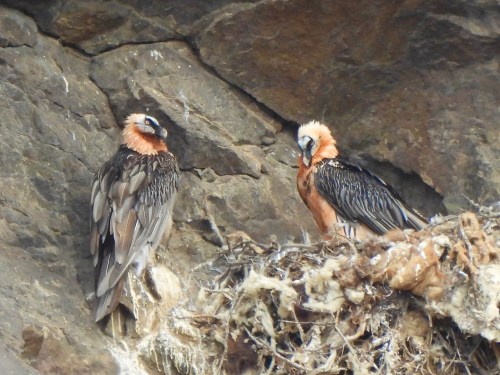
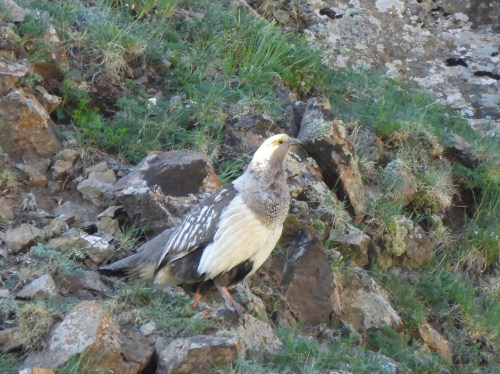
At the same stop, we were amazed to see a pair of Bearded Vultures, also known as Lammergeier, on their nest. Watching those magnificent birds was another wow moment of the trip.
Later that afternoon, we stopped at the site below as we headed into the valley. The road in this area was extremely rocky and the bird life here was a bit different. We saw our only Long-eared Owl of the trip and had our first of only two sightings of Eurasian Wryneck.
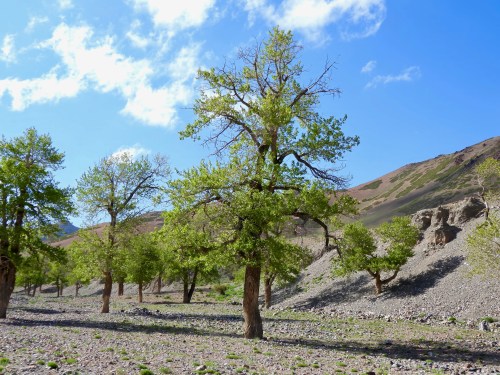
We reached Baga Bogd and set up camp in the valley. I liked this spot. Like so many others, it looks stark in my photos, but a little exploring easily revealed interesting plants, little mammals, and other critters—in addition to birds, of course.

The nice thing about camping is that it’s easy to be birding at 5:00 AM. Our day started with an amazing experience with Altai Snowcock, a definite highlight of the trip. Several males called from the surrounding mountains, and one flew so low over our heads that we felt as if we could have reached up and touched it. After the disappointing view of Caspian Snowcock earlier on our Türkiye trip, this was especially sweet.
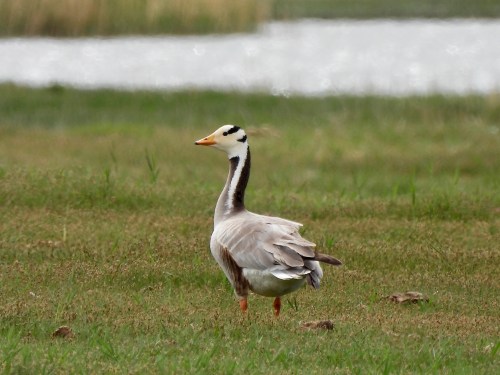
After breakfast and more birding, we set off for our next campsite at Kholboolj Lake, arriving later that afternoon. I got three life birds there: White-headed Duck, Palla’s Gull, and Yellow-breasted Bunting. I was also happy to get great looks at an old favorite, Bar-headed Goose. I fell in love with this species on my first trip to China in 2009 and it remains my favorite goose.
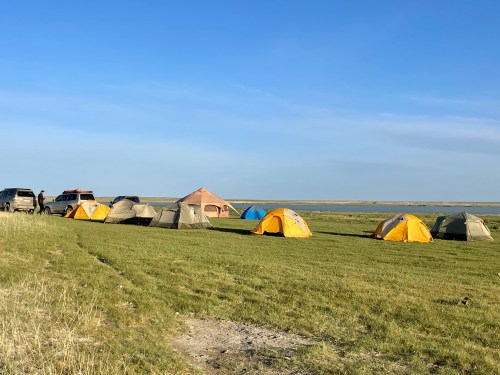
Our camp was on the shore of Kholboolj Lake.
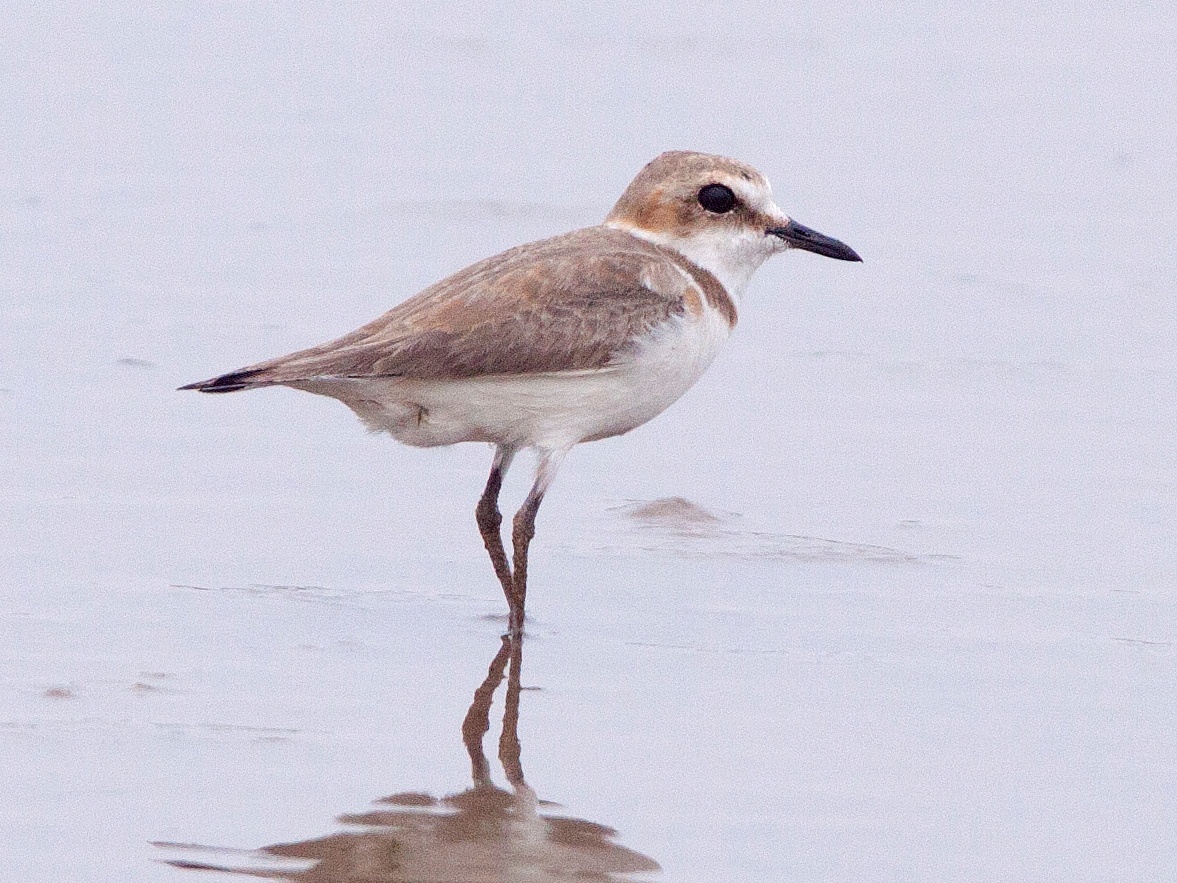
We birded again at Kholboolj Lake in the morning. The British birders loved the lakes, but I’m spoiled by birding at home in Florida, where I can see shorebirds as close as ten feet. In Mongolia, nearly all the shorebirds and ducks were far out on the vast expanse of water or distant shore. I also noted “lots of invisible biting bugs” in my journal. A few birds were closer, though, and I was pleased to have a nice view of this sharp Kentish Plover on the grassy lake edge.

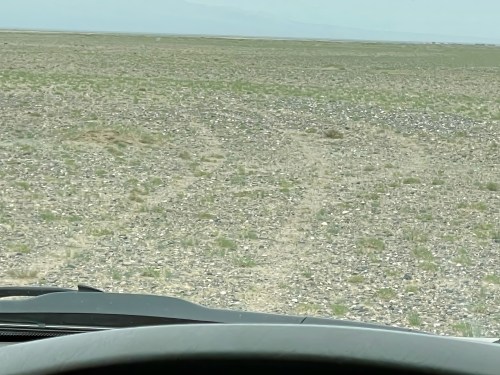
I took the photo below later that day on our drive from Kholboolj Lake to Böön Tsagaan Nuur, but it could have been taken on nearly any day of the trip. This is why you don’t go to Mongolia on your own and try to do a self-guided trip. We spent very little time on actual paved roads; we spent many miles almost every day on “roads” like this. I couldn’t recall any road signs, but someone said they had seen two signs in the past week.
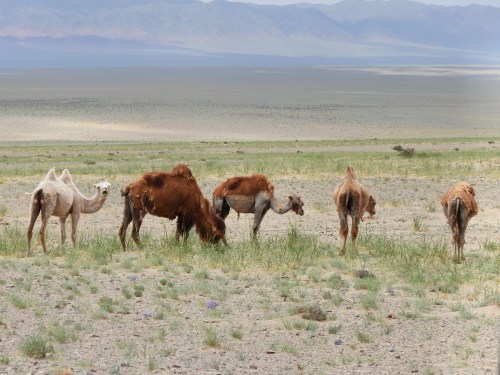
We passed small groups of Bactrian camels several times during the trip. There are no fences in Mongolia, yet somehow the owners manage to keep track of their free-roaming animals. These were domesticated camels—also known as two-humped camels or simply Mongolian camels—although a small number of wild Bactrian camels still survive in remote areas.
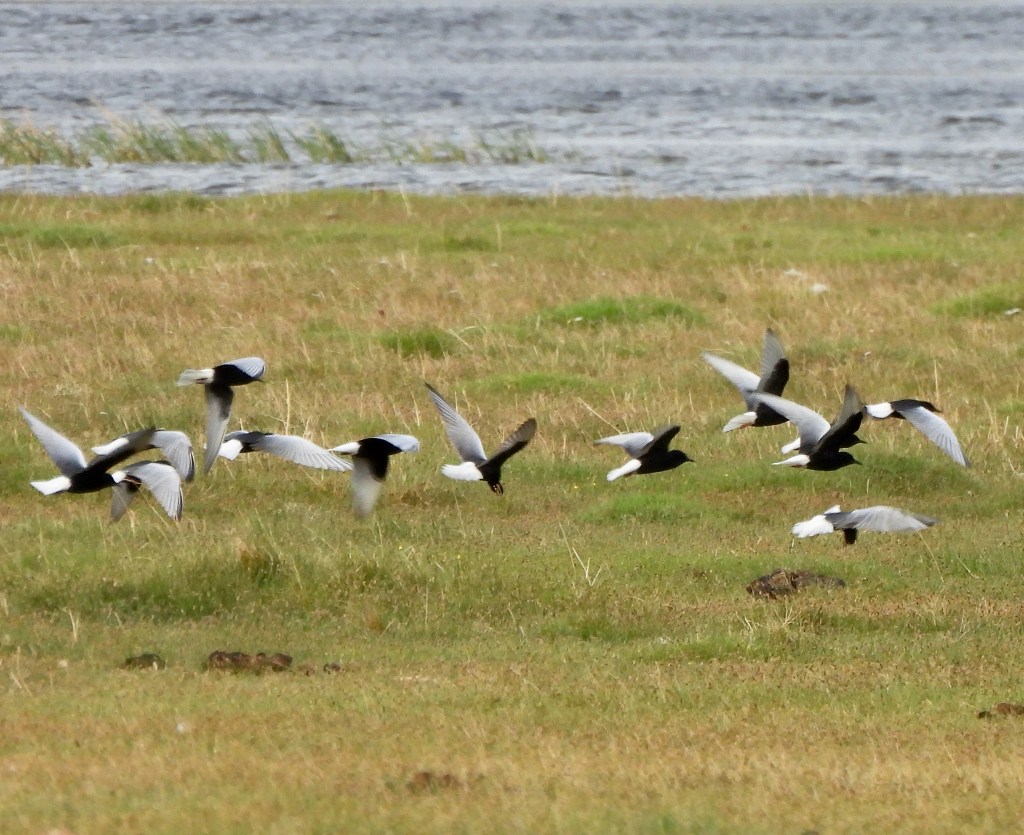
We arrived at Böön Tsagaan Nuur, a vast Ramsar wetland, late in the afternoon and had about two hours for birding. In that short time, we saw over 50 species—mostly ducks, shorebirds, gulls, and hundreds of White-winged Terns. I was mesmerized by the lovely, graceful terns. The photo below shows just a small part of the flock as they flew together over the marshy edges of the lake.
We stayed in a “basic” camp that night (and the next) due to expected wind and rain. We slept in little log cabins with hard wooden beds and our sleeping bags on top of the beds. Other than cabins replacing tents, it was essentially camping: our own toilet tent, no electricity, and minimal comfort. I did not sleep well on the hard bed; early in the night, I thought that I felt something furry run across my arm, and then I heard noises until morning.

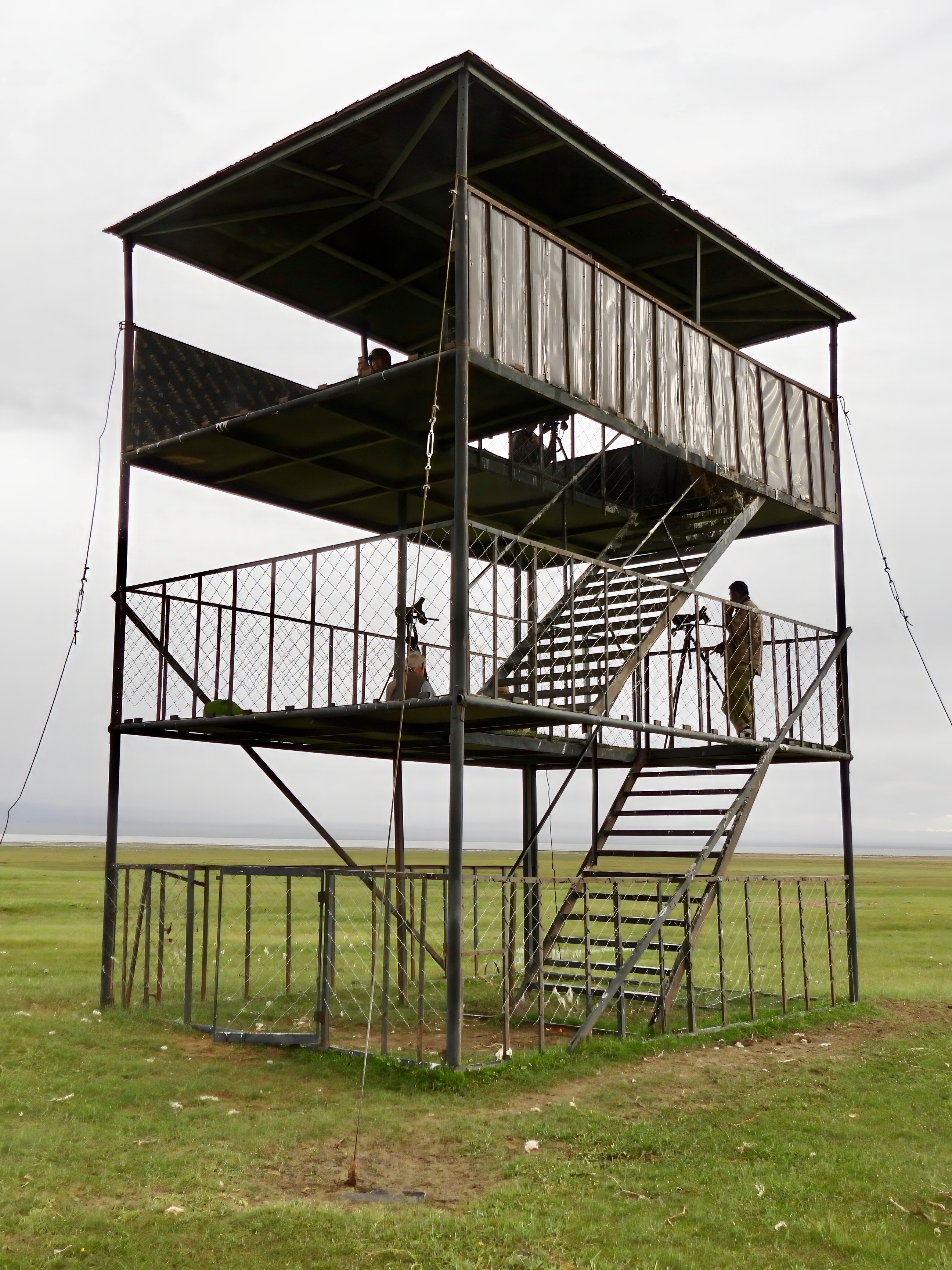
We spent all day at Böön Tsagaan Nuur, seeing many of the same species as the previous afternoon. The best find was a rare drake Baer’s Pochard, but it was sooo far out on the lake. While the lakes host large numbers of birds, they are not ideal for photography. Below, the viewing platform and a couple of the birds that we saw up closer, a Swan Goose and a Pacific Golden-Plover.
Our time at the lake ended with this spectacular sunset.

We stayed another night at the same “basic” camp, making this the fourth consecutive night without showers. Amazingly, I hadn’t noticed any offensive body odor when we were together in the vehicles. I used copious amounts of hand wipes to clean up and assumed that others did the same. Nick, however, claimed to have stripped down and poured a bucket of water over his head behind his cabin. I did not witness said event, so I can’t vouch for it.

May 29 was mostly a travel day with a long drive to Khangai Mountain. We enjoyed more beautiful scenery and blue skies. Mongolia has earned its nickname, “Land of Eternal Blue Sky,” with over 250 sunny days a year like this.

Camping that evening at Khangai Mountain would be the coldest night of the trip, but I was glad to leave behind the invisible (and some not-so-invisible) biting insects from the lakes. What will we find the following day? Watch for part 3 to find out!

Read Full Post »

The Chinese Crested Tern, a close relative of the Sandwich Tern, was our goal for the final segment of the Zoothera Global Birding trip to China in May 2012.  This Critically Endangered tern with a total population of less than 50 birds is much rarer than the Giant Panda.  It is declining rapidly for various reasons, including egg collection (for food) and the aggressive development of China’s coast with its resulting habitat loss.

Little Tern.  Lovely, but not our target.

After a short early afternoon flight from Nanchang to Fuzhou, we started out towards the MinJiang Estuary.  The roads were so narrow that we had to switch to two smaller vehicles for this part of the trip.  After we drove as close as possible, a boatman took us a few kilometres along the channel to the edge of the estuary.  We then waded across a coastal tidal creek and were finally able to start searching for the tern.  We saw Great Crested Tern, Little Tern, and shorebirds, but the Chinese Crested Tern eluded us except for a fleeting fly-over observed by the others.  But I did not see them well enough to count.  The dense mist made viewing conditions awful and I missed many of the shorebirds, too.  We returned to the boat and were ferried to our vehicles in the fading light.

Kentish Plover

The next morning we left the hotel at 4:40 AM to try again for the tern.  The weather was even worse than the first day with rain in addition to the mist.  Luckily, the rain stopped by the time we reached the channel to the estuary.  Our boatman ferried us across, but the mist was still very dense and we could not see more than 50 yards.  We decided to wade across the channel to the other side of the estuary.  Walking out there was like plodding through four inches of mud the consistency of glue with several inches of water on top of it.  My wellingtons were a size too big and I couldn’t get my balance.  With each step, as I pulled one foot out of the muck, the other foot sunk deeper.  Finally, I lost my equilibrium and the mud won, sucking me down until my clothes and binoculars were covered with the thick gooey stuff.  Menxiu, our Chinese guide, saw what happened and came back to pull me out of the muck.  I laughed and trudged on.

Shelley at MinJiang Estuary.  Photo by Raymond Shewan.

The mist continued to present such a challenge that I asked if anyone was interested in splitting the group so that some of us could leave.  Two others were also ready to go, so we left with Menxiu, while Nick and the remaining two birders stayed to continue their search for the tern.

Chinese Crested Tern. My big miss for the trip.

I was so happy to be off of the mud flats that I didn’t care if I missed the tern.  Our little group immediately started seeing new birds as soon as we were back on solid ground.  I finally had a great look at a Eurasian Hoopoe, which I had missed earlier in the trip.  And we saw two Black-winged Cuckooshrikes mating!  The others soon caught up with us, their luck having changed shortly after we left.  They were elated with their views of the Chinese Crested Terns.  So, everyone was satisfied with their morning as we set off for lunch and then Fuzhou National Forest Park.

The park was just what its name implied – a park in a forest – and it was one of the most beautiful places that we visited.  We saw some nice birds that afternoon, including a Blue Magpie.

Blue Magpie (also called Red-billed Blue Magpie)

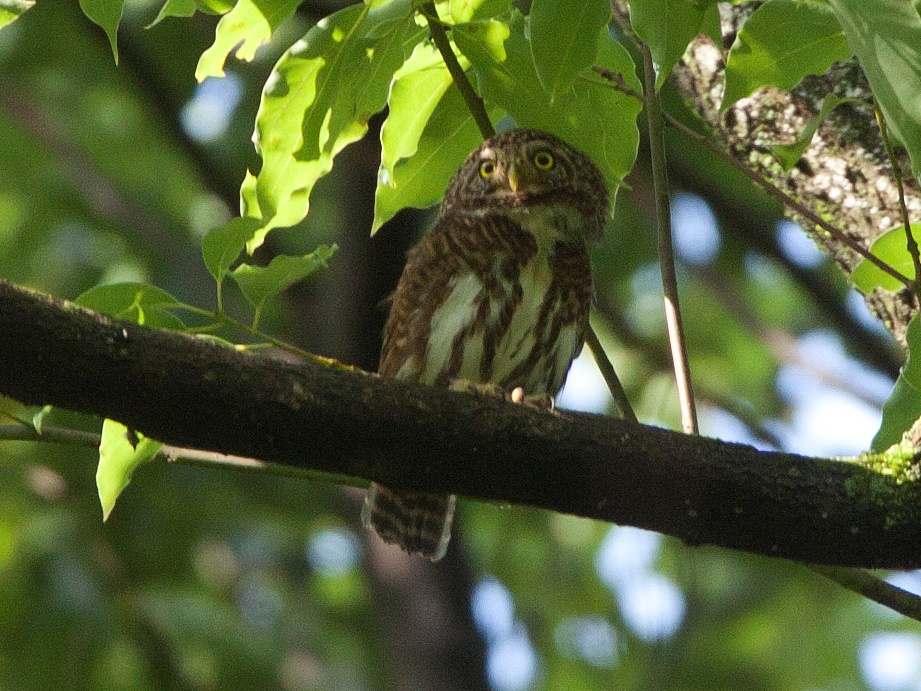
One of the group’s favorites was this Collared Owlet.

Collared Owlet

The next morning we went to Fuzhou National Forest Park again.  I loved the park, but I was getting tired by the last few days of the trip.  While I was tired with a general lack of energy, some of the others were tired of Chinese food.  We actually broke down and ate at KFC a couple of times.  The food was similar to any other KFC, but the drinks were different.  There were no diet drinks and no water; just Coke and fruit juice.  One frustration we had during the entire trip was the unavailability of cold water to drink.  Early on, we had given up asking for water and just started drinking beer with every lunch and dinner.  Beer was served refreshingly icy cold and it seemed to be cheaper than water.

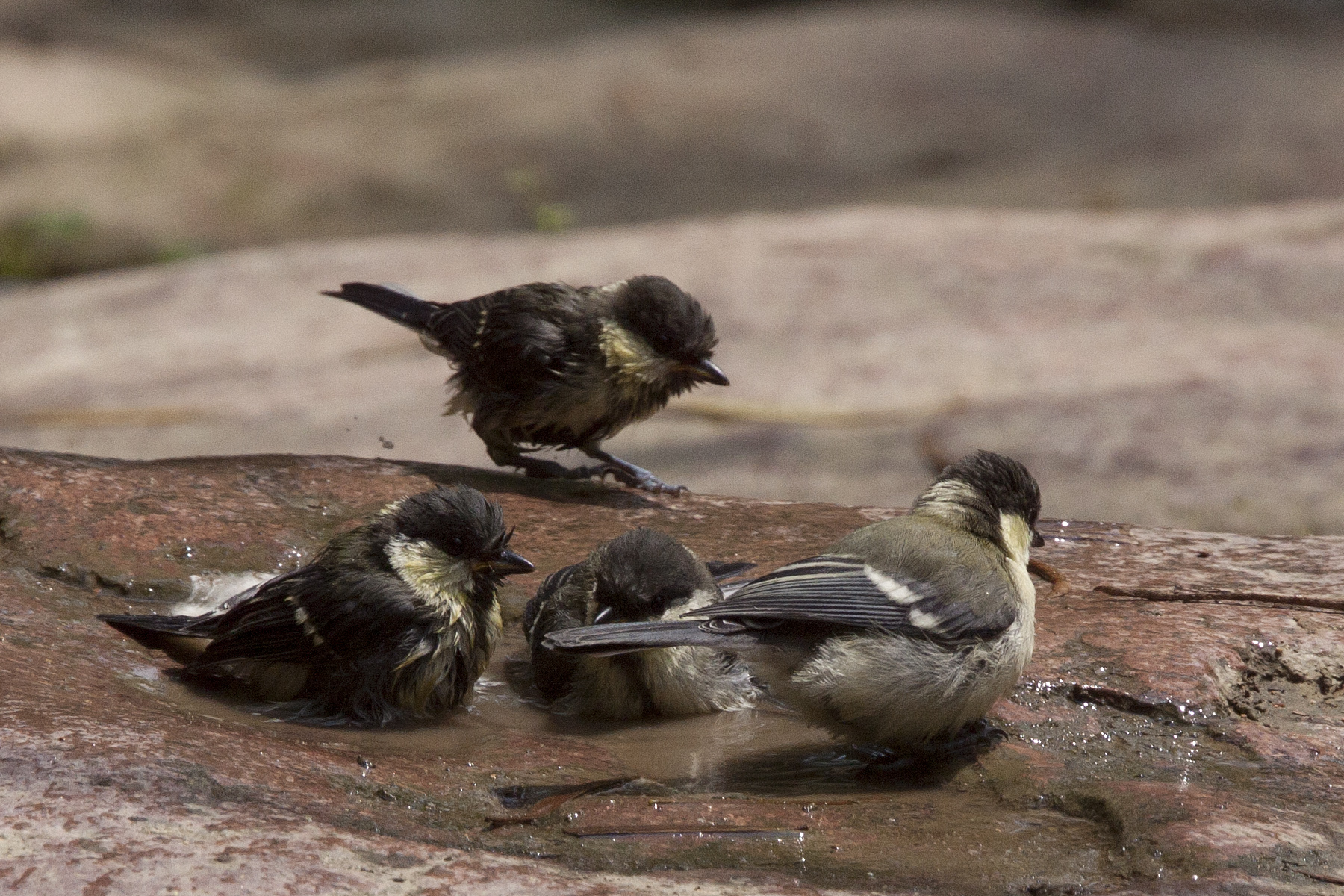
At Fuzhou National Forest Park, the paths were pretty much constant up and down.  After an hour or so, I announced that I wanted to go back to the car to wait for the group.  But, I learned that the trail that we were on was a loop and we were in the middle.  There was no easy way back to the car.  So, I continued on with the group and was glad that I stuck it out.  The last new bird of the trip was a stunning Slaty-backed Forktail, which I would have missed if I had gone back.  Another fun sighting was this family of Great Tits bathing.

Great Tit family bathing at Fuzhou National Forest Park.

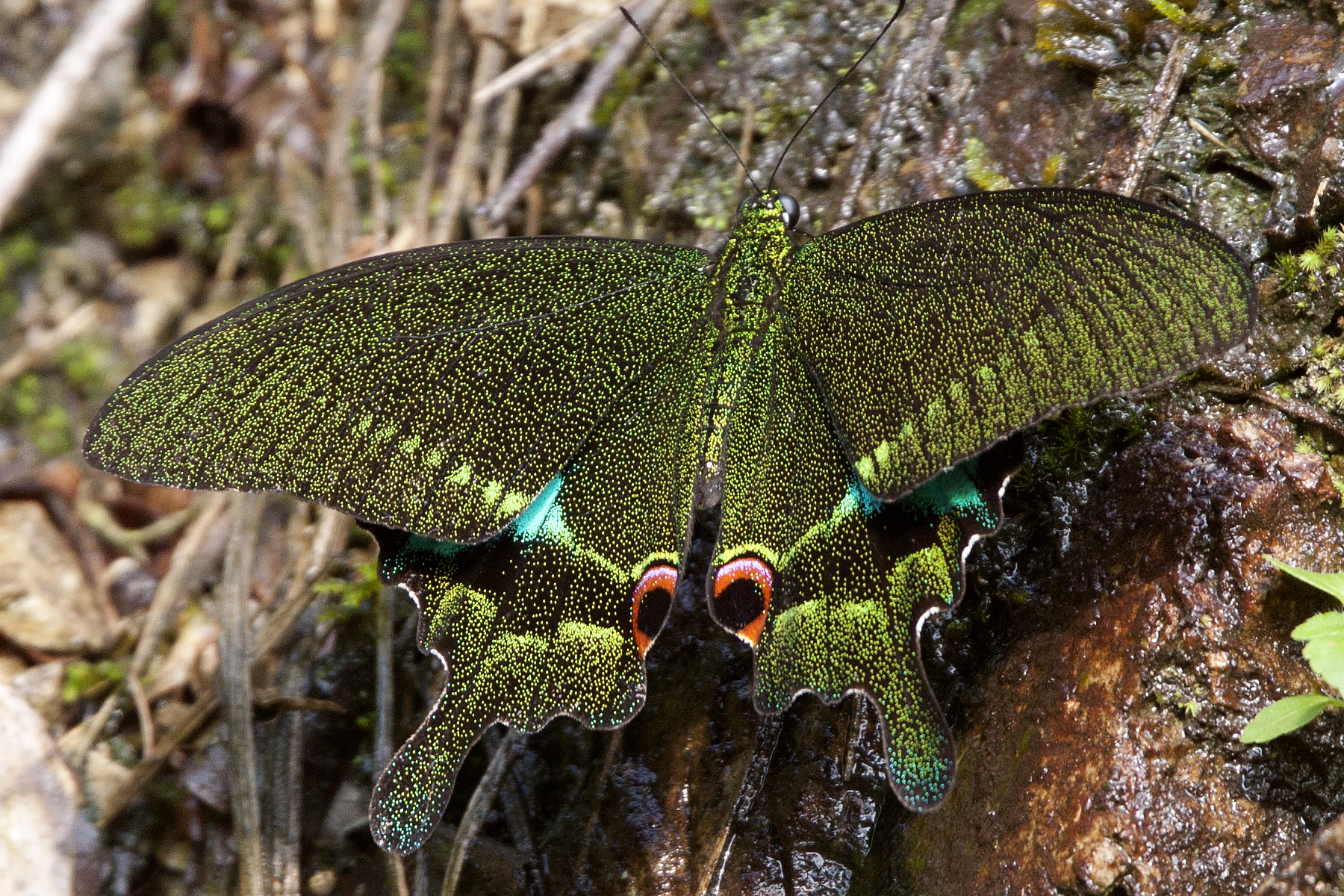
Fuzhou National Forest Park also had quite a few butterflies.  My favorite was this Papilio paris.  Those metallic greenish blue spots on the hindwing are rather large and shimmer when this gorgeous butterfly is in flight.

Papilio paris, my favorite butterfly of the trip.

After a lovely but tiring morning, we headed to the airport for our flight to Shanghai.  It was the end of the Zoothera birding trip.  I said “goodbye” to Nick and the other guys in our group.  They had all been kind, patient, and helpful and we had shared many laughs together in addition to seeing rare and wonderful birds.  I had not just survived; I had enjoyed the trip.  The next morning, I took a flight to Beijing to meet my son, Dave.

Thanks once more to Tony Mills for the use of his photos. For more of Tony’s work, see Photo Art by Tony Mills and Not Just Birds.  For Nick’s official trip report, see SE China 2012.  The dates for this part of the trip were May 13-15, 2012.

Crested Myna, a bird frequently seen on the trip.

Read Full Post »