Feeds:
Posts
Comments

Posts Tagged ‘Long-billed Curlew’

David flew home on Monday morning, June 12. I was tired after all the adventures of last few weeks, so I took it easy the rest of the day and revisited Custer State Park. This time I stopped and walked around beautiful Sylvan Lake.

I enjoyed the walk even though I did not see a lot of wildlife other than a few families of Canada Geese on the lake with their adorable goslings.

Next, I drove the 18-mile wildlife loop road again. eBird lists 167 species for this hotspot, but I reported only 15 species that day. I believe that I would have seen more if I had started earlier in the day and been more familiar with all the trails and side roads. Regardless, I was happy to have another visit to Custer State Park. I saw a few birds, Common Ringlet butterflies, and some interesting plants, mostly on the Prairie Trail.

Do you remember Scott Rager from my last post? I had met Scott at the LAK Reservoir near Newcastle on the day that I drove from Deadwood to Edgemont. I find most birders to be friendly and generous, but Scott was exceptional. He offered to spend an entire day with me, so we met on Tuesday morning. We started at Ruby Canyon, where I had unsuccessfully searched for Virginia’s Warbler in 2018. Scott had seen Virginia’s there recently and he got a quick look again with me, but I wasn’t fast enough to see the bird. We spent a long time at the watering trough, but the much-wanted warbler did not show up. The Chipping Sparrows loved the water, though, as did a pair of Black-headed Grosbeaks.

Roby Canyon was the only location during the trip where I saw the gorgeous Weidemeyer’s Admiral, a new butterfly for me.

After a delicious lunch at a local Mexican restaurant, we birded a few areas near Newcastle. We added several common Western species to my list and a “rare” (flagged as such by eBird) Eastern Phoebe, normally a more Eastern species, that Scott had found earlier in the breeding season. I had started the day with 45 Wyoming birds and had 60 by the time we headed to Scott’s place as dusk approached. As we sat watching the feeders and chatting, it seemed that we were too late to see a Lewis’s Woodpecker. Then, just before dark, this stunning bird came in for a late dinner. Scott sometimes has half a dozen of these gorgeous birds in his yard, but I was thrilled with just this one. I’ve never had better looks and it was a wonderful end to a great day.

The next morning I got a little later start than I’d wanted and I had to go to the grocery store. The hotel I would be staying at that night had suggested that I bring food as there was none available there. Later in the day I would regret the delay, but by day 19 of a trip I am not my most efficient. So, I headed south and after a quick spin through Lusk Cemetery (Orchard Oriole, Wyoming #63), I was in Nebraska.

The drive to Henry Road was a bit longer than I had expected and I arrived at 11:12 AM. Henry Road is a dirt road on open range and I did not see another person the entire time I was there. I did not see a lot of birds either, but this location is popular among birders for the prized species that do occur. I saw Horned Larks on the fence wires and in the road, a common bird in the West and not my target.

The avian stars of Henry Road are the longspurs – Chestnut-collared and Thick-billed.

I did not get great photos of either longspur as I’d hoped, but these are special birds, and it’s always a treat to see them. Sadly, their range is quickly shrinking. Just a few years ago, they were regularly found in Thunder Basin National Grasslands, where I had been a few days earlier, but none were reported in Weston County (Wyoming) this year.

I also saw quite a few Lark Buntings. Below, a female or immature bird, which looks so different from the adult male.
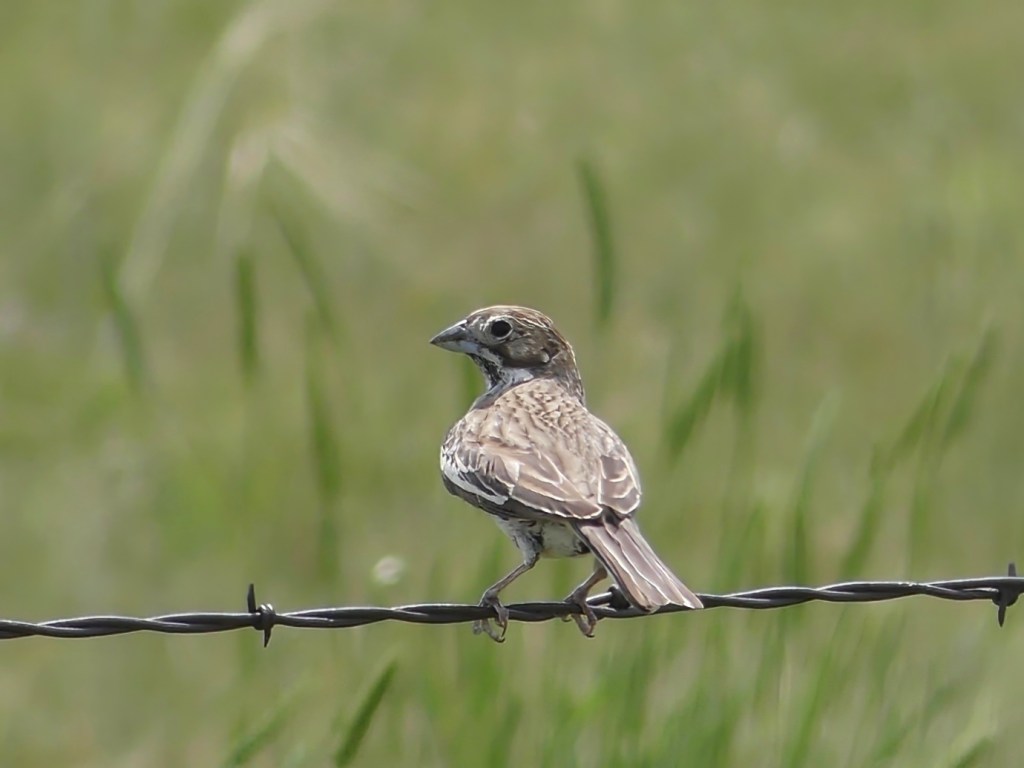
Another treat was a singing Brewer’s Sparrow.

I spent over 3 hours on Henry Road, much longer than I had intended, and my exit was delayed even more by these cows. There was a cattle guard between my car and the cows and fences on both the right and left sides of the road. The only way out was where those cows were standing. They were oblivious to my horn and just did not want to budge. Once again, I’m sure my friends worry about all the wrong things on my solo road trips. Who would have guessed that a herd of cows would hold me hostage? After much slow and tedious effort, I was able to get through an inch at a time. Literally, those cows would back up only one small step when I slowly crept forward.

Finally, I was back on the highway and drove towards the little town of Lakeside. From there, I turned south towards Crescent Lake NWR for 28 miles on a once-paved road now just crumbling asphalt, dirt, and rocks. I didn’t mind the road at all; my only regret was getting there so late that I could not spend hours and stop as often as I wanted to soak in the beauty. It was amazing and my words are inadequate to convey the awe I felt as Long-billed Curlews and Willets flew overhead calling.

American Avocets, the color of dreamsicles as a friend once described them, Wilson’s Phalaropes, and multiple species of ducks foraged in the little ponds.

I saw several Upland Sandpipers. I am pretty sure that this one and another that was with it are “teenagers.”

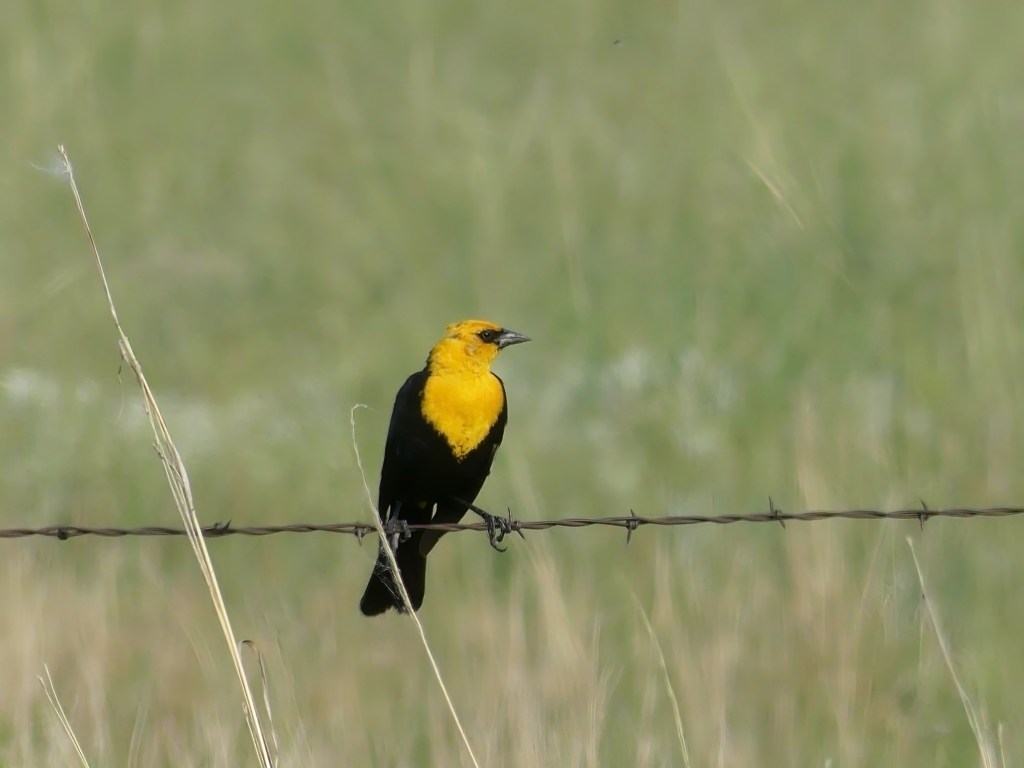
Yellow-headed Blackbirds are one of my favorites.
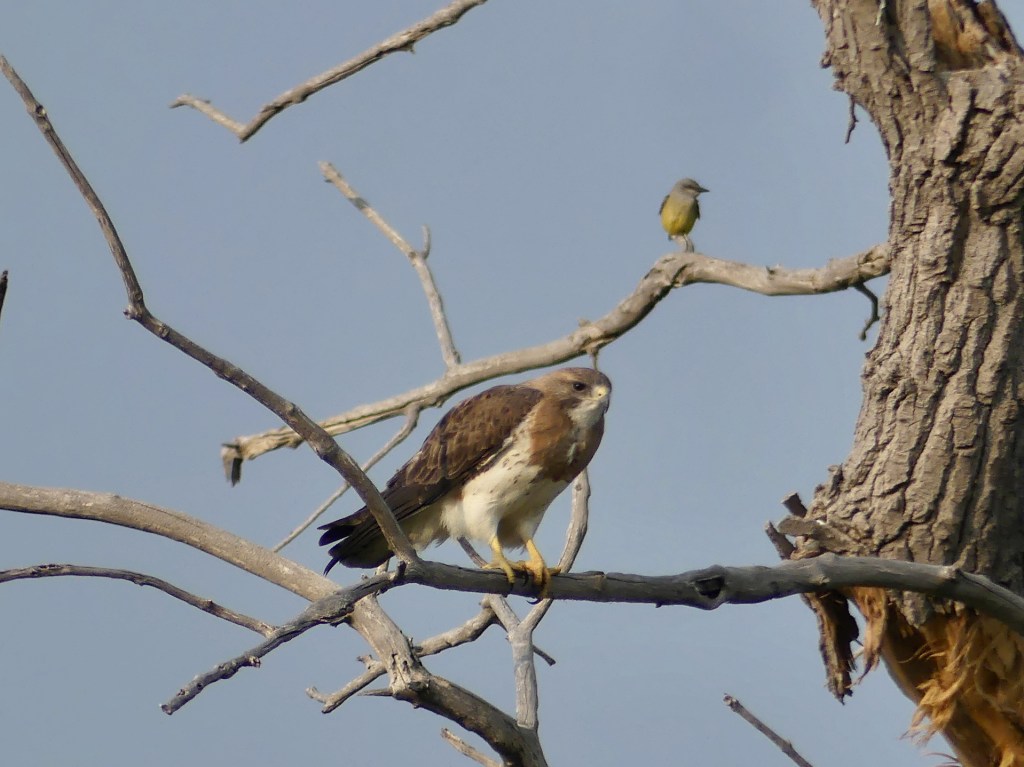
I can’t leave out a Swainson’s Hawk on any story about a trip west. This one came with a bonus Western Kingbird.
This pretty Ornate Box Turtle was also on the road to Crescent Lake NWR.

Because of my poor time management earlier in the day, I had only 2-1/2 hours on this incredible road. This is my favorite kind of birding and I’m now inspired to do a “dirt and gravel road” trip out west.

All that was left after this wonderful day was the long, tedious drive home. I didn’t have quite as much ambition for county birding and iNat as I had on the long drive at the start of the trip. I put in some effort, though, and was rewarded with a Giant Walkingstick at a McDonald’s drive-thru window in Oklahoma.

I accidentally reset my trip meter, but I’m pretty sure that I drove about 6,250 miles on this trip. It was a lot of time behind the wheel, but the rewards were worth it.
Read Full Post »

I woke up on March 21 to find a text message from my birding pal Derek.  Two spots were available on the Field Guides grouse tour in April; would I like to go?  Well, yes, of course, I would like to go!  I know several people who have done the “chicken run” on their own, but I had no desire to find the best locations, make the arrangements, and then drive 2,500 miles getting to all the leks.  I had not planned to take another birding trip so soon after China, but this was too good to pass up.  I responded “Yes!” to Derek and a couple of hours later we were both officially signed up for the trip.

I had never been to Colorado and I was looking forward to seeing rugged landscapes like this.

I had never been to Colorado and I was looking forward to seeing rugged landscapes like this.

The focus of the trip would be viewing Greater and Lesser Prairie-Chickens and three additional species of grouse on their leks.  You might be wondering “What’s a lek?”  While a dictionary defines a lek simply as a “communal area in which two or more males of a species perform courtship displays,” they are far more.  Leks are hotbeds of social activity excitingly described in the Audubon article, What the Heck Is a Lek? The Quirkiest Mating Party on Earth.  In between the leks, we would search for several other uncommon species of birds that are highly-sought by birders.  Additionally, this trip usually provides interesting sightings of mammals.

Here’s a preview of the Greater Prairie-Chickens that we would soon be watching on a lek at a cattle ranch in Colorado.

Derek and I wanted to stay a couple of extra days in Colorado after the tour to look for any species that we might have missed or just get in a little more birding.  We spent two hours on the phone searching for flights from Baltimore for Derek and compatible flights from Greensboro for me.  We couldn’t seem to make it work, so we decided that I would just drive up to Baltimore and we’d fly to Denver together from there.

A Bald Eagle, our national bird, in our nation's capital

A Bald Eagle, our national bird, in our nation’s capital

I arrived in Maryland a day early, supposedly to take it easy and rest for the big trip.  But, of course, our birding obsessions would not allow any downtime.  I’m currently trying to get birds in all of the lower 48 states.  Derek assured me that the District of Columbia counts as a state-level entity, so we spent our first day there.  We had fun despite the intermittent rain and I got 43 species, not bad considering that the expected waterfowl were absent.  Derek even got two new D.C. birds, Red-breasted Nuthatch and Vesper Sparrow.

The next morning, April 13, we caught an early flight to Denver and rented a car so that we could do a little birding before officially starting the tour later that afternoon.  We checked out nearby Rocky Mountain Arsenal NWR where we had a nice transition to Western birds.  It was fun seeing Black-billed Magpie, Say’s Phoebe, and Western Meadowlark alongside many birds that we also see in the East like American Avocets.  We were also excited to see the first of three prairie dog species that we would encounter during the trip.

I had a close view of a Red-tailed Hawk on our first afternoon in Colorado. They were very common and we would see too many to count during the coming days.

I had a close view of a Red-tailed Hawk on our first afternoon in Colorado. They were very common and we would see too many to count during the coming days.

At 2:30 PM, we met the other eleven participants and our trip leaders, Cory Gregory and Doug Gochfeld. We piled into the two fifteen-passenger vans that would be home for the next 10 days and after quick introductions we were on our way towards Kansas.  I was happy that Cory was one of the leaders as I had met him in Alaska (Alaska 2015: “The Pit Stop is Cancelled”) and knew that he was a great guy in addition to an expert birder.  On our way to Pueblo, Colorado, where we spent the first night, we stopped to look for Western Screech-Owl in a driving rain that eventually turned to snow.  We joked about the weather throughout the trip, saying that we experienced everything except a tornado.  Sadly, we did not have any luck with the Screech-Owl; this was one of the few misses of the trip.

Curve-billed Thrasher in the early morning fog. Photo by Derek Hudgins.

Curve-billed Thrasher in the early morning fog. Photo by Derek Hudgins.

On the first full day of the trip, we enjoyed many stops for birding as we continued to head east towards Kansas.  Our first stop was magical, almost spiritual, as we listened to a Curve-billed Thrasher singing in the early morning light.  No other vehicles were on our section of the gravel road and we heard no sounds of civilization; it was just us and the birds.

As the fog dissipated, we continued down the road, getting our first of many excellent views of Pronghorn, an iconic symbol of the West.  Suddenly Derek called out a bird that had been missed.  We backed up and saw a singing Scaled Quail on a cholla cactus on the side of the road.  In this awesome encounter, the bird stayed in that spot for a while, then hopped down, ran across the road, and perched up on a barbed-wire fence where he continued to sing.  We were all thrilled with close looks at this gorgeous bird, which was later voted one of the group favorites for the trip.

Scaled Quail. Can you see why he’s sometimes called “cotton top”?

Scaled Quail. Can you see why he’s sometimes called “cotton top”?

Later that day, we picked up more classic Western species like Yellow-headed Blackbird, Clark’s Grebe, and Lewis’s Woodpecker.  The best part of the afternoon was birding at Neenoshe Reservoir, where we met Colorado birding legend Tony Leukering and Derek got life bird #1,000 – Long-billed Curlew.

Derek's photo of his 1,000th life bird, Long-billed Curlew at Neenoshe Reservoir.

Derek’s photo of his 1,000th life bird, Long-billed Curlew at Neenoshe Reservoir.

The following day, April 15, we visited our first lek, on a Nature Conservancy property in Kansas, to observe Lesser Prairie-Chickens.  We followed the usual protocol for lek viewing and arrived at the blind well before dawn.  We settled into our places on the bench in the metal blind and sat as quietly as possible for the next few hours.  We heard the chickens in the darkness before we saw them.  With the rising sun, silhouettes became visible.  Finally, we saw the entire drama play out before our eyes as the prairie-chickens danced the same dances and observed the same mating rituals as they have for thousands of years.

Female Lesser Prairie-Chickens

Female Lesser Prairie-Chickens

Sadly, the Lesser Prairie-Chicken has suffered huge population declines since the 1800’s.  The IUCN (International Union for Conservation of Nature) lists the species as “vulnerable” due to its restricted and patchy range.  In 2014, it was listed as “threatened” under the Endangered Species Act, but that ruling was overturned the following year.  Legal battles to protect the Lesser Prairie-Chicken have continued since with a lawsuit to make a decision on listing the species as endangered or threatened likely to be filed soon.  Here is the most current information that I could find, which includes both a biological and legal history.  Regardless of legal status, the prairie-chickens are clearly losing ground due to habitat loss with global warming looming as another threat to their survival.  Cory mused that the Lesser Prairie-Chicken is the most likely bird in the lower 48 states to go extinct in our lifetimes.

Male Lesser Prairie-Chicken displaying on the lek. Photo by Derek Hudgins.

Male Lesser Prairie-Chicken displaying on the lek. Photo by Derek Hudgins.

After viewing the Lesser Prairie-Chickens, we turned back West and birded along the way to Wray, Colorado, with a quick stop in Nebraska, which gave one participant her last state to be visited.  After checking into our hotel, we headed over to the Bledsoe Cattle Ranch for a warm welcome from Bob Bledsoe, a partner in the family-run business.  The ranch has won many awards, but we were also impressed by the Bledsoe’s good stewardship of the land which hosts about 100 Greater Prairie-Chicken leks on its 75,000 acres according to Bob’s estimate. Bob was a good representative for the fascinating Bledsoe family; we enjoyed Bob’s stories and our Q&A session.

On April 16, we arose in the wee hours again, this time to see Greater Prairie-Chickens on the Bledsoe ranch.  The routine was similar, arriving before dawn, but this time we watched the birds from the vans and two pick-up trucks.  Derek and I were lucky to get one truck to ourselves, a great help in getting photos.  As with the Lesser Prairie-Chickens, the birds displayed mere feet from us as we quietly watched.

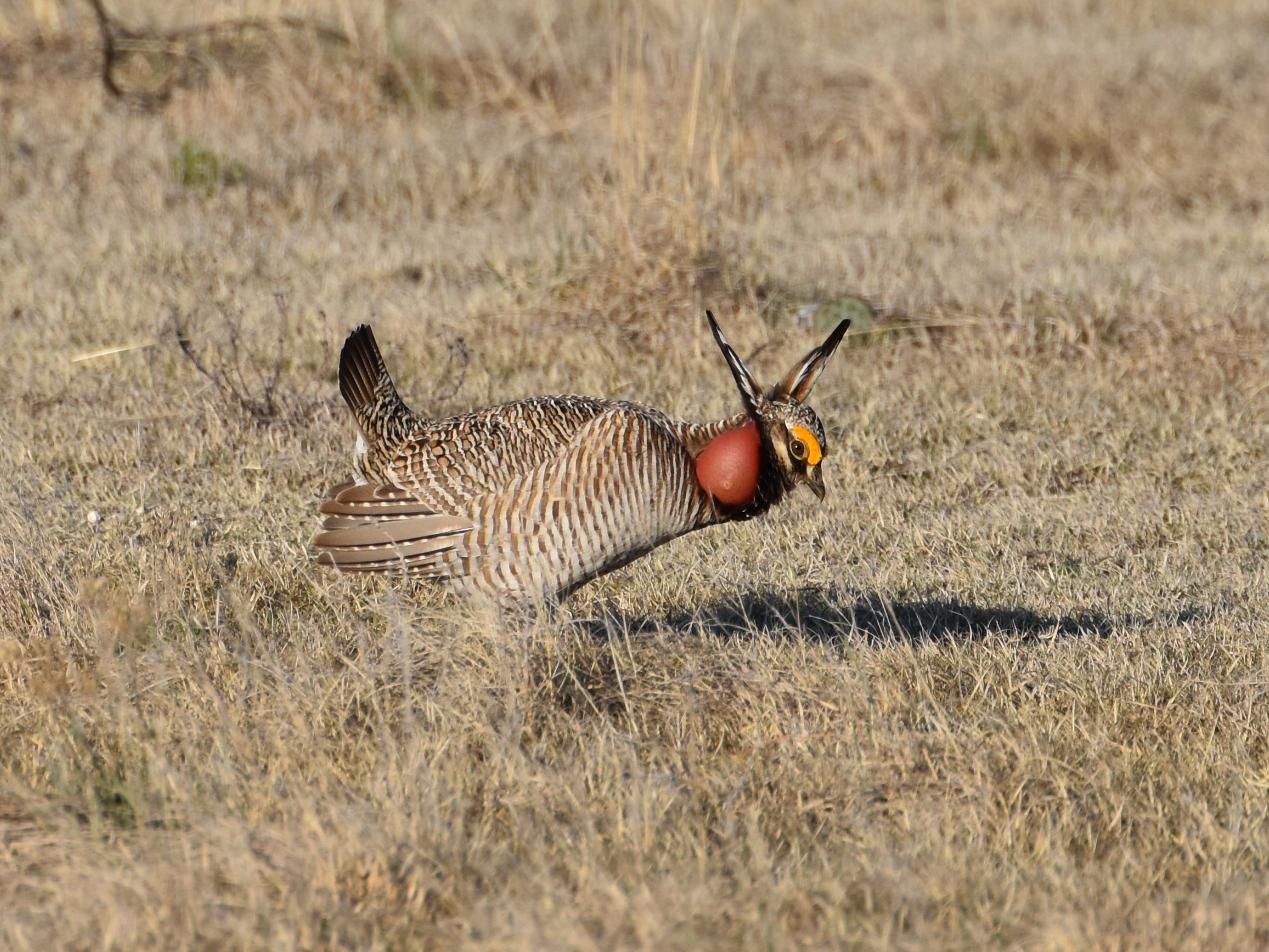
Male Greater Prairie-Chickens challenge each other on the lek.

Male Greater Prairie-Chickens challenge each other on the lek.

Greater Prairie-Chickens are very similar to Lesser Prairie-Chickens, but slightly larger.  The most noticeable difference is that the gular air sac on the side of the neck is orange to yellow during the breeding season while the air sac of the male Lesser Prairie-Chicken is red.  Although numbers of Greater Prairie-Chickens have declined, they have a wider range and larger, more secure population than Lesser Prairie-Chickens.

A male Greater Prairie-Chicken booming on the lek.

A male Greater Prairie-Chicken booming on the lek.

This charismatic species was my favorite member of the grouse family.  Not only were they beautiful and interesting birds, but the males put on the best vocal show with their booming, cackling, and whooping while dancing and strutting.  Greater Prairie-Chickens are so well-known for their booming sounds that their leks are often referred to as “booming grounds.”

Male Greater Prairie-Chickens step up their game as they fight for the best territories on the lek. Photo by Derek Hudgins.

Male Greater Prairie-Chickens step up their game as they fight for the best territories on the lek. Photo by Derek Hudgins.

I couldn’t help but wonder how the bizarre lek mating system evolved.  Darwin’s theory of natural selection, commonly referred to as survival of the fittest, explains much about evolution, but it can’t explain how non-adaptive characteristics arise.  Features such as the peacock’s long tail actually harm survival by making it difficult to flee from predators.  Darwin realized this and developed his second theory, sexual selection, to explain the emergence of traits which do not aid and may even hinder survival, but give one individual an advantage over other individuals of the same species in obtaining mates.  Darwin suggested two mechanisms of sexual selection: mate choice and competition for mates.  Competition for mates (especially among males) is obvious and generally accepted by scientists as a function of sexual selection.  But mate selection is more complicated.  In his popular book, The Evolution of Beauty, Richard Prum passionately argues that it’s the female’s innate sense of beauty that explains mate choice, but other scientists disagree.  Many questions remain and grouse are frequently studied in ongoing research on sexual selection.  During the ten days of the grouse tour, we would simply thrill in the displays of the males strutting their stuff and the discerning females making their choices.

Two female Lesser Prairie-Chickens evaluate their choices. Photo by Derek Hudgins.

Two female Lesser Prairie-Chickens evaluate their choices. Photo by Derek Hudgins.

We saw a few females at both prairie-chicken leks and several others in our group observed mating.  They reported that all the females choose the same male.  This is typical; the dominant couple of males in a given lek will likely mate with about 90% of the females.  The females then leave to build a nest, incubate their eggs, and raise the chicks on their own without any help from the male.

Great Horned Owl. Photo by Derek.

Great Horned Owl. Photo by Derek.

We continued to enjoy sightings of many other species as we drove back to Denver.  The group liked this Great Horned Owl on her nest that we stopped to observe on our way out of the Bledsoe ranch.  Highlights later that day were Mountain Plovers, Burrowing Owls, and a large flock of 150 McCown’s Longspurs at Pawnee National Grassland.  The longspurs were more distant than we would have liked, but, along with the Mountain Plovers, they were life birds for several in our group.

Next on this wonderful trip – grouse leks!  Stay tuned for more Colorado grouse tour adventures.


Driving through Pawnee National Grassland. Photo by Derek Hudgins.

Driving through Pawnee National Grassland. Photo by Derek Hudgins.


Read Full Post »

Osprey at Honeymoon Island

Osprey at Honeymoon Island

Thanksgiving week started early with Nate Dias’ Curlew / Marsh Sparrow boat trip in the Cape Romain NWR on November 18.  My goal was to get a good look at a Saltmarsh Sparrow, which would be a life bird for me.  I stopped at Huntington Beach State Park on my way down where I missed all three marsh sparrows which were seen before I arrived.  I was disappointed, but I had good looks at four individual Clapper Rails – swimming, walking, and bathing.

As we left the dock in McClellanville the next morning, duck hunters were returning saying that the weather was too bad for them!  It was very cold and windy and it rained most of the day.  Nate reported the most marsh sparrows in a couple of miles that he had ever seen, including “12-13 firmly identified Saltmarsh Sparrows.”  However, I did not get a good enough view of any to count as a lifer.  It was fun to put faces with familiar names from the Carolinabirds listserv, though, and it was a good trip in spite of the weather.

On Monday, I birded Altamaha WMA with Sandy Beasley, whom I had met in January at the Georgia Ornithological Society meeting.  I had birded Altamaha before, but did not know the area at all well.  Sandy showed me new areas on the west side of the road and we had a very nice day.  Now I know where to find birds as well as where to go for a great lunch!

Quinn

Quinn enjoying a beautiful Thanksgiving day in Jim & Debbie’s yard

Acacia and Casey

Granddaughter Acacia (Debbie’s oldest) holding Casey (Liz’ youngest)

Thanksgiving with my stepdaughters Debbie and Liz was wonderful.  Debbie’s significant other, Jim, and I birded together again this year.  He took me to Watermelon Pond, a place where he has fished for 20 years.  Jim had not been there lately, though, and was surprised to discover that the lake was dry and the area is now an official Wildlife and Environmental Area.  I was thrilled to discover this wonderful place that focuses on preserving several Florida Threatened species including Southeastern American Kestrel and Gopher Tortoise.  We saw Kestrels and I also had my best look ever at a gorgeous adult male Northern Harrier at Watermelon Pond.

The highlight of Thanksgiving was not birds, though, but seeing the wonderful progress that Liz’ autistic two-and-a-half-year-old daughter, Quinn, is making.  I visited in August, just before she started ABA therapy (Applied Behavioral Analysis).  The difference in her behavior and interactions with people in just three months is remarkable.  Her progress includes a little eye contact now, a huge step for an autistic child.

Limpkin

Limpkin at Kapok Park

American Oystercatcher

American Oystercatcher on Courtney Campbell Causeway

I headed to Dunedin the day after Thanksgiving to spend the weekend with good friends David and Val.  David and I birded our favorite spots on Friday afternoon and talked about Quinn in between birds.  Her therapists were using an iPad with her so I wanted to get a tablet that Liz could use with her, too.  We considered options and compared Android devices to the Apple iPad for a couple of hours before deciding upon an iPad.  David, ever smart and creative, devised a plan that would allow us to bird all the way to the Apple store.  We saw some of our favorite birds along the way – Limpkins at Kapok Park and American Oystercatchers on the Courtney Campbell Causeway.

John Hood, President of Clearwater Audubon, and I had met in August at the Hog Island Audubon camp in Maine.  On Saturday, David and I birded with John.  We learned where to park for the Tierra Verde “duck ponds” and finally got to see the hundreds of Redheads that winter there.

At Fort De Soto, John easily found the Long-billed Curlew that has been there for two years.  David and I had been unable to find it on my last visit.  We enjoyed John’s company and learned a lot about birding in Pinellas County due to his local expertise.

Least Sandpiper, Sanderling,a nd Dunlin at Fort De Soto

Least Sandpiper, Sanderling, and Dunlins at Fort De Soto

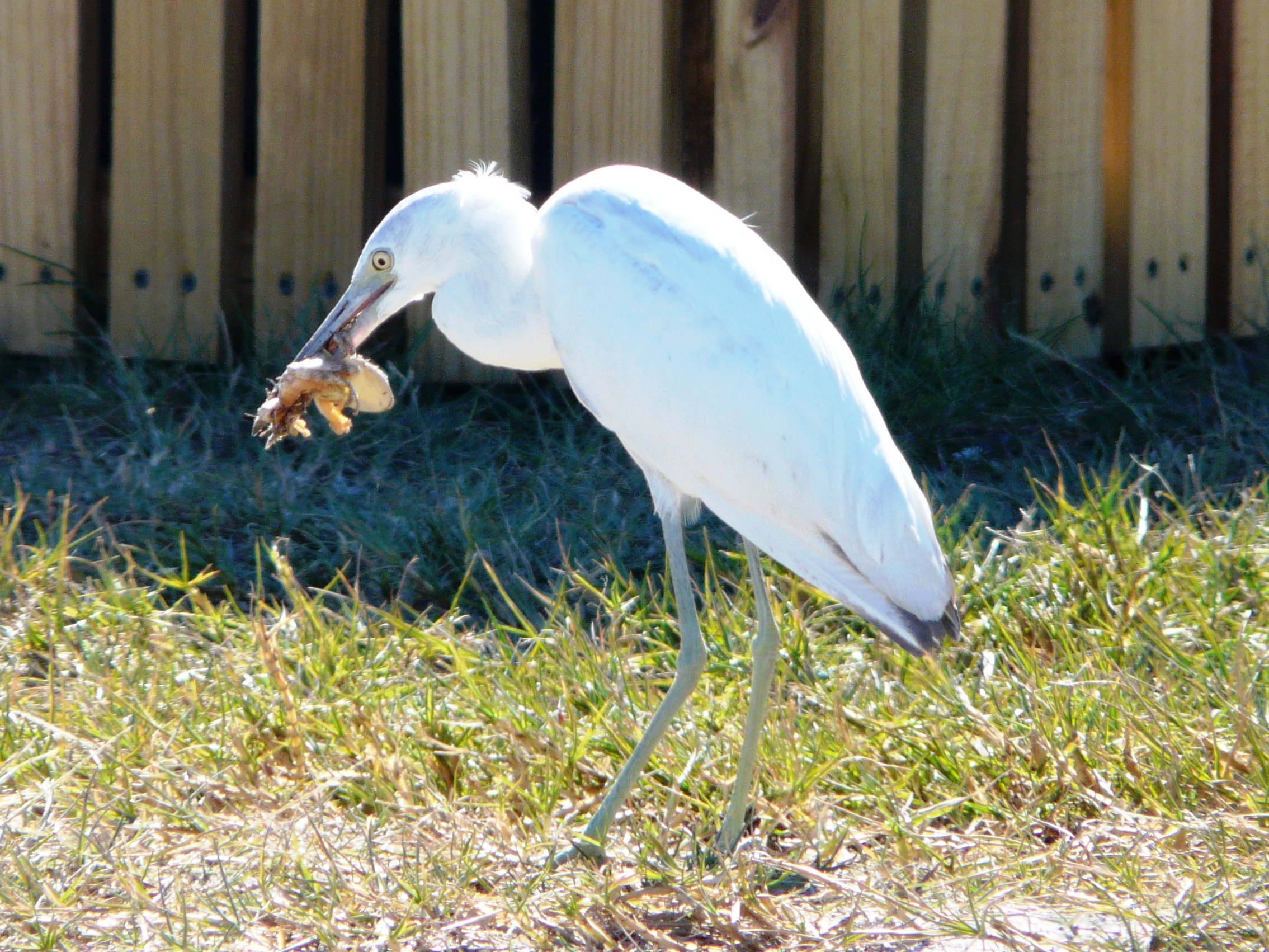
"My frog is still wiggling"

“My frog is still wiggling.”

"Maybe if I squeeze real hard"

“Maybe if I squeeze real hard.”

"Shaking is good, but I'm getting weeds on my frog"

“Shaking is good, but I’m getting weeds on my frog.”

"He's subdued now, but I still can't get it down"

“He’s subdued now, but I still can’t get it down.”

"I'll try scrunching it up into one big bite."

“I’ll try scrunching it up into one big bite.”

On Sunday, David and I headed to Honeymoon Island where we enjoyed the “usual suspects” including many Ospreys. We are fascinated with herons attempting to eat large prey and watched a juvenile Little Blue Heron struggle with a large frog.  Before we could see how this story would end, a biker came along and the heron flew off with his frog.  We hoped that the frog made a good lunch.

It was time to head home on Monday morning, but my adventures were not quite yet over.  My plan was to stay in Hardeeville and bird at Savannah NWR on Tuesday morning.  As I passed the turn-off for Tybee Island, I impulsively decided try for the Saltmarsh Sparrow at Ft. Pulaski.  I called Sandy Beasley that evening and she gave me very detailed directions to where she had seen the sparrows earlier in the month.  There would be a high tide at 6:41 AM, so I decided to go for it.

I arrived at 7:30 AM and was disappointed to find much vegetation visible in the marsh.  The birds could be anywhere and I was afraid that I had missed them.  With a little patience, though, I did find the birds and got a great look at one Saltmarsh Sparrow only a foot from the log that Sandy had described.  I was thrilled to get a life bird, but greedy for more birds, continued on to Savannah NWR.

Savannah NWR is one of my favorite places and I stayed from 9:30 AM until after 3:00 PM.  I “should” have left for home much earlier, but by staying so late my last bird of the trip was a really good one – a White-winged Scoter near the end of the Laurel Hill drive.  A check of eBird records when I got home revealed only one other sighting in Savannah NWR and it was over six years ago.


I arrived safely home, very tired but grateful for the wonderful birds that I had seen and especially thankful for my loving family and friends.

White-winged Scoter

White-winged Scoter – Savannah NWR Laurel Hill drive

Read Full Post »